
Is Fiber Cement Board Fire Resistant?
Is Fiber Cement Board Fire Resistant?
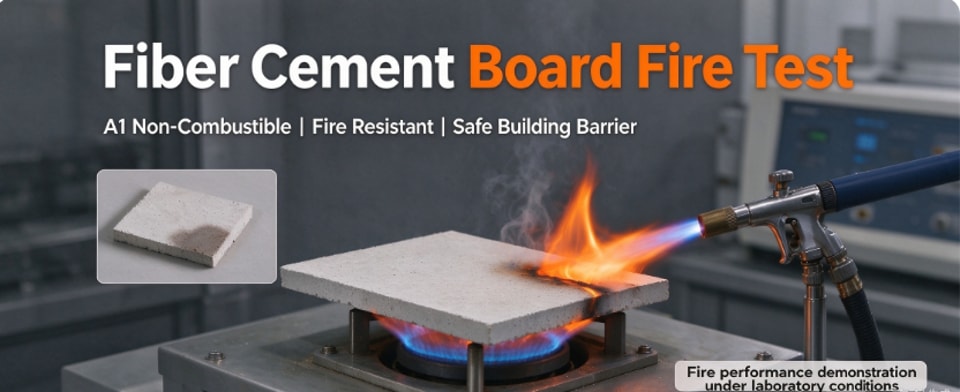
Yes, when the board is genuine fiber cement and the question is about the material. Our panels are classified Noncombustible to AS 1530.1:2024, with no sustained flaming in any test specimen.
That answer is worth little alone, because "fire resistant" hides three different claims. This page separates them, then covers what buyers ask next: density, thickness, interior use, painting and Hardie board.
Fire resistant, fireproof, noncombustible: three claims
These words are used interchangeably in sales copy and they are not the same claim.
Noncombustible is a test result. A specimen sits in a furnace at a defined temperature and is judged on whether it sustains flaming and how far its surface temperature rises. It is a property of the board.
Fire resistance, in the code sense, usually means a fire-resistance level in minutes: integrity, insulation and load-bearing capacity of a complete assembly. That is a property of the wall, not the panel, and it needs a full-scale test of the whole build-up.
Reaction to fire is a classification (A1, A2, B and so on under EN 13501-1), combining combustibility, spread and smoke into one European label.
So when a supplier says fiber cement siding is fire resistant, ask which of the three they mean. And when a tender asks for a "fireproof fiber cement board", it usually means noncombustible material plus a rated assembly, which are two separate submissions. Fireproof is not a classification in any standard we test against.
The tests we hold, and what each proves
Three SGS reports, all on our non-asbestos fiber cement board.
AS 1530.1:2024 — noncombustibility. Five specimens, 30 minutes. Sustained flaming: 0 seconds on every specimen. Furnace temperature rise 2.6 °C; specimen surface rise 6.4 °C against a 50 °C threshold. Mean mass loss 38.4 %. Deemed Noncombustible. Report AJFTS25007286R01_EN.
AS/NZS 1530.3:1999 — spread, heat and smoke. Six specimens, none ignited. Ignitability index 0, spread of flame index 0, heat evolved index 0, smoke developed index 5. Report AJFTS25006840R01_EN.
AS 5370:2024 — asbestos. All six regulated types not detected by polarised light microscopy, limit 0.1 % by weight. Report SHAIN26003172701, under CNAS accreditation.
Two numbers deserve comment. The 38.4 % mass loss reads alarming until you know what is lost: the furnace drives off chemically bound water from the cement matrix, and that release is the mechanism keeping the surface cool, which is why it rose only 6.4 °C. The smoke index of 5 is mid-scale, not zero, and anyone quoting "zero smoke" from a 0/0/0/5 result is misreading their own document.
What these reports do not cover
The limits matter more than the passes, because this is where projects get caught.
There is no fire-resistance level. We have not tested a complete wall to AS 1530.4, so we will not quote −/60/60 or any minute rating. If your project needs one, it comes from a tested system of named components, and the panel is one input, not the answer.
There is no EN 13501-1 classification. Noncombustible to AS 1530.1 does not equal A1 or A2. There is no ASTM E84 or E136, the usual North American route. We also have not tested the coating as a separate contributor, and on a facade the coating is a thin organic layer on an inorganic substrate.
None of that makes the product unsuitable. It tells you which markets the documentation serves: Australia and New Zealand, where these three standards are what gets asked for. Everywhere else, assume a test is missing until you see the report.
Density and thickness: what they change
Density is the specification most often missing from a quotation, and it decides impact performance: a denser matrix resists point loads better and is stronger in flexure at the same thickness.
The problem is that "high density fiber cement board" is a marketing phrase with no number attached. Ask for the tested value in kg/m³ and which sample it came from. A figure without thickness and a report is not a specification. Our catalogue and SGS sample disagree on this value, so it is withheld until reconciled: better to omit it than print one we cannot defend.
Thickness is the other half. Our standard panel is 16 mm against a market default of 6 to 12 mm for flat sheets. Stiffness rises with the cube of thickness, so 16 mm is roughly eight times as stiff as 8 mm at the same span. Thickness of fiber cement board does not create a fire rating on its own, but a thicker sacrificial layer above the reinforcement extends the time before fire reaches it. The full comparison is in how thick is fiber cement board.
Interior walls, and painting the board
Interior wall fiber cement board is the same material doing a different job, and the difference is in the joints. Outdoors the panel is a drained, ventilated skin with open joints. Indoors it is a lining behind tile or paint, so joints get filled and taped, and joint compound becomes part of the system instead of something to avoid. Wet areas are where it replaces gypsum board, which disintegrates when wet. A noncombustible lining on a stud wall also buys time in a corridor or escape route without the weight of masonry.
Most people who paint fiber cement board on site meet one of three failures. An unprimed cut edge absorbs water faster than the face and blisters first, so prime before fixing, while the top edge is still reachable. A primer that is not alkali-resistant can lose adhesion from underneath, because fiber cement is alkaline. And sealing the open joints to hide them blocks the drainage path, pushing water sideways into the cavity.
Our panels leave the factory with primer and finish applied on one spray line under a single batch record, so site work is limited to cut edges and touch-up.
Is fiber cement the same as Hardie board?
No. Hardie board is a brand of fiber cement made by James Hardie. Fiber cement is the material category, covering many manufacturers, formulations, densities and thicknesses.
The confusion is understandable: in some markets the brand became the generic word. But a specification that says "Hardie board" names a supplier without naming a product, and the products under that name differ by market and use.
What matters is that the material is fiber cement, that dimensions and thickness suit the fixing system, and that the reports belong to the product being shipped rather than to the brand on the brochure. A brand name travels well in a specification and says almost nothing about the panel that arrives on site. Our panel is 3,030 × 455 × 16 mm with a textured face, a different product from the flat sheets most people picture — compared in fiber cement siding vs cement board.
What to ask a supplier
Five questions, and the last one sorts them.
Which standard was tested, and to which edition? A report to a superseded edition is a different document.
Which sample was tested — thickness, density, face? A report issued against a 10 mm flat sample does not describe a 16 mm textured panel.
Is the coating part of the tested system, or was the test on bare board?
Does the board contain asbestos, and was it tested to a current method rather than a declaration?
Which classifications do you not hold? The gaps tell you more than the passes.
A supplier who answers all five in writing has read their own documentation, and is the least likely to leave you arguing with a building surveyor after the panels are up. Keep the answers in the project file: if the facade is ever queried, the reply is a scanned document rather than a recollection.
FAQ
Is fiber cement board fireproof? No material is fireproof in the absolute sense. Our board is Noncombustible to AS 1530.1:2024, with zero seconds of sustained flaming in the test.
Is fiber cement siding fire resistant? As a noncombustible cladding it adds no fuel to a facade, and the flame-spread test recorded zero ignitability, spread and heat release. The wall's fire-resistance level still depends on the assembly.
Can fireproof fiber cement board be used without other fire protection? Only where the code accepts a noncombustible lining alone. Where a rated assembly is required, the panel is one component and the system must be tested whole.
What thickness of fiber cement board is fire rated? None, on thickness alone. Our standard panel is 16 mm, but a fire-resistance level depends on the tested assembly.
Does fiber cement board contain asbestos? Modern fiber cement does not. Ours was tested to AS 5370:2024: all six regulated types not detected, limit 0.1 %. Fiber cement from before the 1980s needs testing before demolition.
Contact Us