
Fiber Cement Siding vs Cement Board: What Goes Where
Fiber Cement Siding vs Cement Board: What Goes Where
"Cement board" is a shopping term, not a product specification. It covers at least three different things: a backer board that sits behind tile, a fiber cement siding that forms the finished face of a wall, and an architectural facade panel designed as part of a rainscreen system. They share a cement-based core and almost nothing else about how they are used.
Choosing between them is a question of role, not of material. Get the role right and the rest of the specification follows: fasteners, joints, coating, and what has to sit behind the board.
The three roles, and what each one requires
| Product | Intended role | What to verify before ordering |
|---|---|---|
| Exterior-rated cement backer board | Substrate beneath an approved finish | Approved finish types, framing, fastening schedule, exposure limits |
| Fiber cement siding | The finished exterior face | Climate suitability, clearances, flashing, coating system |
| Architectural facade panel | Panel within a defined rainscreen assembly | Subframing, joint design, drainage, attachment details |
The distinction matters because the documents are not interchangeable. A backer board's literature tells you which tile adhesives and membranes it accepts. A siding's literature tells you what happens at a corner and how far the panel must sit above grade. A facade panel's literature tells you the connector, the cavity and the joint width.
When people search for exterior building materials and end up comparing these three by thickness or price per sheet, they are comparing the wrong variables. Thickness tells you how a board performs in its own role. It does not tell you whether the role is the one your wall needs.
Where the wrong product gets used
The most common error is treating an exterior-rated backer board as finished cladding. It is exterior-rated because it tolerates weather during construction and because it can carry a finish outdoors — not because its face is designed to be looked at for twenty years. Leave it exposed and you get a surface with no weathering coating, no joint design, and no drainage detail.
The second error runs the other way: buying a large flat sheet because the dimensions match a facade module, then discovering that a 1220 × 2440 mm sheet has no connector system, no cavity detail and no specified joint.
There is also a language problem. "Can you use cement board outside" sounds like a yes/no question, but the answer depends entirely on which product and which assembly you mean — covered in more detail in can cement board be used outside. The short version: the material is fine outdoors, the product and the assembly decide whether it is correct.
Before ordering, ask the supplier to name the exact exterior application their document permits. If the answer is "it's cement board, it's fine outside", you have not received a specification.
What cement board durability covers, and what it does not
Cement board durability is usually shorthand for a set of separate properties that get bundled into one word. It is worth splitting them, because a board can be strong in one and ordinary in another.
The first is strength retention when wet. Our 16 mm panel is tested to GB/T 7019-2024 at 8.6 MPa flexural strength in the saturated state, which is the number that matters for an exterior wall — dry strength is a laboratory curiosity if the panel spends part of the year damp.
The second is movement. Moisture deformation of 0.05% under JG/T 396-2012 sounds negligible until you apply it to a 3,030 mm panel: that is roughly 1.5 mm of movement per board. Joints have to absorb it, which is why an open joint is a design decision and not a gap left by the installer.
The third is coating performance, and it is usually the one buyers skip. The finished face of our 3030 × 455 × 16 mm board was tested under GB/T 9780-2013 by the immersion method and recorded Grade 0 stain resistance; the coating survived 10,000 scrub cycles to GB/T 9266-2009 with no substrate exposure, and 96 hours in saturated calcium hydroxide to GB/T 9265-2009 without discoloration, blistering, flaking, powdering or softening.
What durability does not cover is water transport. A board can absorb moisture into its thickness and still resist passage through it. Our panel absorbs 16.5% by weight at saturation, and under GB/T 30100-2013 testing recorded no damp mark and no water droplet on the back face after 24 hours of standing water. Those two facts are compatible: the board takes water in, and does not let it travel through. That is a board property. It is not a wall property.
Fiber cement siding durability is an assembly property
This is the part that separates a specification from a sales sheet. Fiber cement siding durability in service depends on four things that are not the panel: the framing, the cavity, the flashing, and the fasteners.
The cavity is what lets the back of the panel dry. Without it, moisture that enters at a joint sits against the substrate and the panel never returns to equilibrium. Our panels go through 100 freeze-thaw cycles to GB/T 7019-2024 with no delamination or flaking — a result that only holds in service if the panel is allowed to drain and dry.
The flashing is what stops water reaching the cavity in the first place, at heads, sills, jambs and penetrations. The fasteners are what keep the panel in place under wind load, and they have to be compatible with the exposure: coastal work needs a grade that will not corrode before the coating does.
So when a supplier claims outdoor building materials that last thirty years, the honest version of that claim is: this panel, in this assembly, in this climate, with this maintenance. Ask for the assembly.
Profiles: board and batten and the rest
Fiber cement board and batten siding is a specific look — wide vertical panels with narrow battens covering the joints — and it should be planned as a system rather than improvised on site. The batten spacing sets the rhythm of the elevation, and the batten depth has to clear the panel face enough to cast the shadow line that makes the profile read as intended.
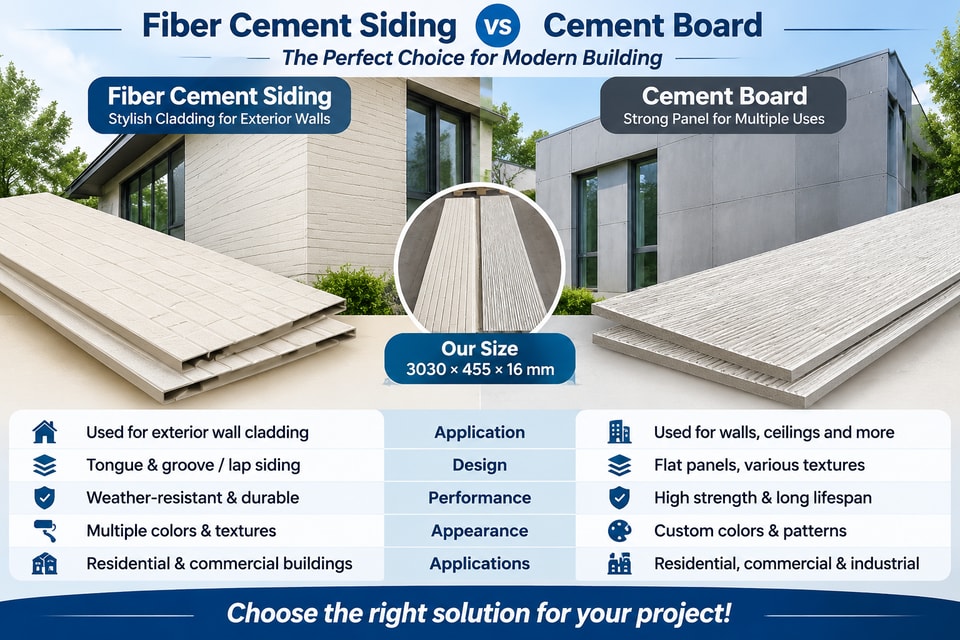
Our range approaches the same design question differently. The panel is 3,030 × 455 × 16 mm, laid as a horizontal course, with the texture doing the visual work rather than an applied batten: wood grain, stone grain, brick pattern, striped texture, flat, and a wood wool acoustic option.
That matters for specification because the two routes fail differently. A batten system adds a fixing layer and a set of vertical joints to detail; a textured panel puts the visual interest in the coating and keeps the joints to a single horizontal line. On a tight programme, or on a wall where the substrate cannot take another layer of framing, the textured panel is often the simpler route to the same architectural intent.
Four claims worth testing before you specify
Exterior facade products are frequently described with four words that sound like specifications but are not. Each is worth converting into a question with a document attached.
E0 eco-friendly. Ask which emission standard and which test report support the label. E0 is used in formaldehyde classifications for certain wood-based products; it does not by itself describe a cement-based facade panel's environmental performance. If a supplier cannot name the standard, the claim is marketing.
Waterproof. Ask whether the claim refers to the panel, the coating, or a tested assembly. These are three different statements, and only the third one describes a wall.
Fireproof. Ask for the fire classification of the exact panel and coating combination. "Fireproof" is not a classification, and applied coatings can behave differently from the board beneath them.
Self-cleaning. Ask what the mechanism is and what maintenance it assumes. On our board this is a measured surface property rather than a slogan: Grade 0 stain resistance to GB/T 9780-2013 means dirt does not key into the coating, so rain carries it off instead of leaving a streak.
A planning sequence for cement board projects
Cement board installation goes wrong before the first screw, usually because the assembly was never written down. Five steps prevent most of it.
First, confirm the application in writing: is the board carrying a finish, or is it the finish? Second, resolve the water path — barrier, flashing, drainage at the base — before anything covers the wall. Third, fix the fastening schedule to the specific product; do not borrow a pattern from another board. Fourth, agree the joint detail and the clearances at edges, corners and grade. Fifth, plan the cutting method: fiber cement cutting generates silica-containing dust, so dust control is part of the method statement, not a personal habit.
For projects where the panel is the finished face, the sequence continues into the installation itself — connectors, cavity, base baffle — which is set out step by step in dry-hung fiber cement cladding installation.
One habit worth building into every project: photograph the wall at each stage, from bare substrate to closed joints. When a question arises two years later about what sits behind panel ten, the photographs answer it faster than any warranty conversation, and they cost nothing to take.
FAQ
Can I use tile backer board as exterior siding? No. An exterior-rated backer board is designed to sit beneath an approved finish. It has no weathering coating or joint design for permanent exposure, and leaving it visible is outside its stated application.
Is cement board waterproof? Not in the sense most buyers mean. A cement board tolerates moisture without losing strength, and a tested panel can resist water passing through its thickness. Water still enters a wall at joints, fixings and cut edges, so the assembly needs a barrier and flashing.
How long does fiber cement siding last outdoors? Longevity is set by the assembly and the climate as much as by the board. A ventilated, flashed, correctly fastened system with a factory coating is a different proposition from the same panel fixed tight to a wall with sealed joints.
Does a thicker board mean a more durable facade? Only within the same role. Thickness buys stiffness and impact resistance. It does not substitute for drainage, flashing or a coating system, and a thick board in a bad assembly still fails.
What is the difference between fiber cement siding and a facade panel? Siding is the finished face of a wall. A facade panel is one component of a defined rainscreen system with its own subframe, cavity and joint design. Ours is specified as the latter: 3030 × 455 × 16 mm on a dry-hung ventilated assembly.
Contact Us