
Fiber Cement Siding Durability Explained
nderstanding the Longevity of Fiber Cement Siding
Fiber cement siding is a durable exterior cladding that can provide decades of service when the product, installation, and maintenance suit the building’s conditions. Its longevity depends on more than the board itself: water management and finish care matter too. Understanding those factors makes it easier to evaluate fiber cement siding durability without mistaking a warranty for a guaranteed lifespan.
How long does fiber cement siding last?
Fiber cement siding can last for decades, but there is no universal service life for every board, climate, and installation. What can be verified is how the panel itself behaves. Our 16 mm board was tested at the China Academy of Building Research, a CNAS-accredited laboratory: after 100 freeze-thaw cycles it showed no delamination or spalling, and its flexural strength in the saturated state measured 8.6 MPa. Treat any warranty as evidence of manufacturer backing, not as a promise that every installation will perform identically.
Separate three considerations when reviewing a proposal: the board’s expected performance, the finish’s maintenance needs, and the warranty’s actual coverage. A surface may need refinishing while the underlying siding remains serviceable. Likewise, a long material warranty does not automatically cover every installation problem or maintenance expense.
Durability starts with water management
Weather-resistant siding is not a substitute for a properly detailed wall. Flashing, a water-resistive barrier, drainage, and specified clearances work together to manage water around openings and intersections. Installation that ignores manufacturer requirements is a recognized cause of poor fiber cement performance.
Ask the installer to explain these details before work begins:
· Window and door flashing: How will water be directed outward at openings and penetrations?
· Roof and ground clearances: How will the crew maintain the product’s required separation from wet surfaces?
· Joints and cut edges: Which locations require flashing, sealing, or another manufacturer-approved treatment?
· Drainage paths: Which gaps must remain open rather than being filled with caulk?
These questions belong in the installation discussion because details differ between products. Requirements that recur across fiber cement cladding systems include flashing at horizontal panel joints and leaving the drainage gap above horizontal flashing open rather than sealing it shut. More sealant is not automatically better protection: a blocked drainage gap traps water against the wall behind the cladding.
How does fiber cement compare with vinyl?
To compare vinyl vs fiber cement siding for durability, evaluate cold-weather behavior, moisture detailing, and maintenance together. Fiber cement products may be engineered for wet and freezing conditions; vinyl installations must accommodate temperature-related movement. Neither material eliminates the need for flashing and a properly prepared wall.
For a useful comparison, request documentation for the specific products rather than relying on broad material rankings. Ask each contractor to show the installation requirements and explain how the proposed wall handles drainage. Also discuss finish upkeep: fiber cement may require repainting, so its long-term appeal should be weighed against that responsibility.
Both belong in a discussion of durable siding options, but the strongest proposal connects product selection to the actual building. A material name alone cannot demonstrate that the crew has addressed vulnerable transitions or followed the correct fastening instructions.
Board textures, dimensions, and shake profiles
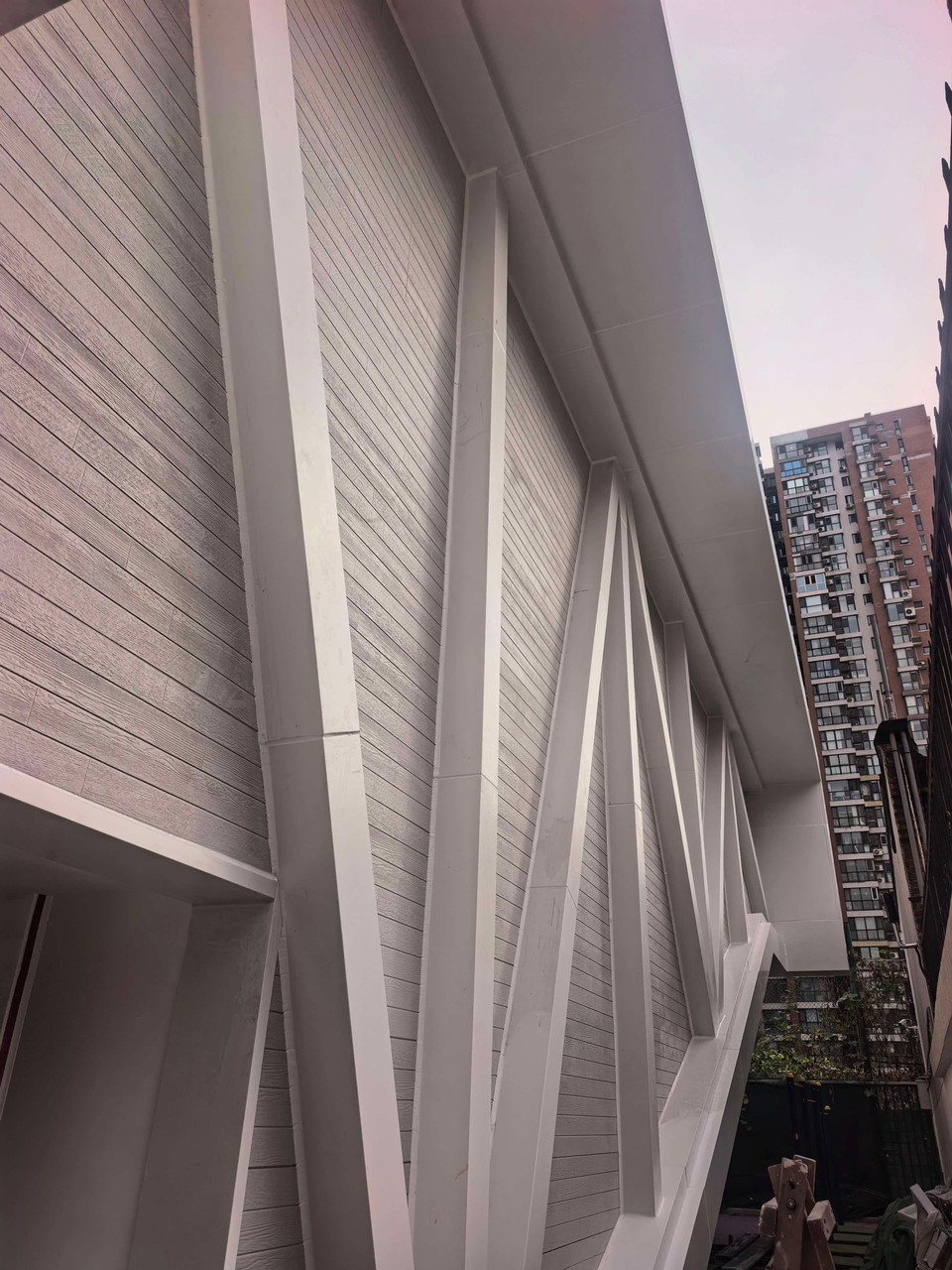
The specified product is a fiber cement board, 3030 × 455 × 16 mm, supplied in wood grain and brick grain face textures. Treat these as product-selection details, not proof of weather resistance, structural capacity, or warranty eligibility. The same panel recorded an apparent density of 1.22 g/cm³ and a water absorption rate of 16.5%, and no water penetrated the board during 24 hours of exposure. Impermeability and absorption are different properties: water does not pass through the panel, but the surface still takes up moisture, so the water-resistive barrier and flashing behind the cladding remain necessary. Request the matching technical sheet before ordering.
When evaluating fiber cement panels, confirm intended exterior use, fastening requirements, finish compatibility, and installation details. A fiber cement panel should be selected as part of a documented wall system, not simply because its dimensions fit the design. Manufacturer technical resources provide the appropriate starting point.
For the best fiber cement shake siding comparison, prioritize longevity and durability documentation alongside appearance. Compare the exact shake products’ installation instructions, finish requirements, and warranties. A convincing wood texture is an aesthetic benefit; it does not replace evidence about performance.
Installation ease and warranty deserve separate checks
Choosing the best fiber cement siding for contractors means balancing installation ease with durability requirements. Review handling, cutting equipment, fastening layouts, and crew familiarity before assuming one format will simplify the job. Manufacturer guidance addresses these practical requirements, including appropriate cutting setups.
Before weighing fiber cement siding pros and cons across brands, identify the exact product and the warranty document that applies to it. Published terms vary by product line, region and purchase date, and prorated coverage is common, so one product’s headline number should not be generalized to another. Confirm applicable support through the manufacturer’s own warranty resources.
Before accepting any warranty comparison, check:
· Whether material and finish coverage are separate.
· Whether benefits decrease over time.
· Which labor or replacement costs are included.
· What installation and maintenance conditions apply.
These distinctions matter more than comparing headline warranty lengths alone.
Maintenance and environmental value
Fiber cement can be a justifiable environmental choice when long service and avoided replacement support the project’s environmental goals. That is a conditional benefit, not a blanket certification. Ask for a product-specific Environmental Product Declaration to assess life-cycle impacts rather than relying on a green label.
Protect the investment with manufacturer-approved cleaning and prompt attention to visible damage. Gentle washing with a garden hose and a soft brush is usually sufficient; sustained high-pressure washing can drive water into joints and damage the finish. The board’s cleanability is measurable rather than assumed: it reached Grade 0 stain resistance and withstood 10,000 scrub cycles without breaking through, which is what keeps routine washing practical. Because the face resists staining instead of absorbing it, rain tends to rinse it more evenly than a porous surface. Keep maintenance instructions with the installation records so future owners can follow them.
The takeaway is straightforward: choose documented performance, insist on correct installation, and plan for upkeep. Fiber cement’s longevity is strongest when the board, finish, and water-management details work together—not when durability is treated as maintenance-free ownership.
References
· IIBEC Technical Advisory No. 017-2019: Fiber Cement Siding – Inherent Issues Affecting Performance
· Environment Product Declaration (EPD) International Library – fiber cement cladding EPD
Contact Us