
Can cement board be used outside
Can cement board be used outside
Yes, cement board can be used outside when the specific product is approved for exterior applications and installed as part of a suitable wall system. The important distinction is between cement backer board beneath a finish and fiber cement panels designed as siding. Choosing correctly means checking the board’s intended use, moisture protection, and installation requirements—not simply whether it contains cement.
Which type of cement board belongs outside?
Exterior-rated cement backer board belongs beneath an approved finish, while fiber cement siding belongs on the exposed face of an exterior wall. These products serve different purposes, even though shopping descriptions sometimes group them together. Backer board is built to carry a finish bonded to its face, so its own surface is never meant to stay visible. Fiber cement cladding is built to be that finish, with a factory coating, a profile and a joint detail of its own.
Before buying exterior cement board, decide what the finished surface should be:
· Tile or thin brick: Choose an exterior-approved backer board and compatible finish system. Follow the finish manufacturer’s requirements for bonding materials and joint reinforcement.
· Visible siding: Choose purpose-made fiber cement cladding rather than assuming ordinary tile backer board can remain exposed.
· A direct-applied textured finish: Confirm that the board, basecoat, reinforcement, and finish are approved together. Exterior suitability depends on the assembly, not just the sheet.
If you are comparing cement board uses, start with the installation document rather than the product’s appearance. Ask the supplier to identify the exact exterior application it permits. A board suitable behind tile is not automatically interchangeable with cement board siding.
Is cement board waterproof outdoors?
It depends which question you mean. Cement board does not swell, rot or lose strength when it gets wet, which is why it is used outdoors at all. Whether liquid water passes through the board is a separate test, and not every cement board is put through it. Ordinary tile backer board is expected to be covered by a finish, so its literature describes it as water-durable. An exterior cladding board that stays exposed should be tested for water impermeability, and that result is the one worth asking for.
If your search started with “cement waterproof,” separate the two things: whether water damages the board, and whether water crosses it. The Shengbaoqiang board was tested for water impermeability under GB/T 30100-2013, and report BETC-T4BC-2026-01542 records that after 24 hours of standing no damp mark and no water droplet formed on the back face. The same report lists a water absorption rate of 16.5%, so the board does take moisture into its own thickness. What it does not do is let water travel through to the other side.
That result describes the board, not the wall. Water enters a cladding assembly through joints, fixings and cut edges, so an exterior system still needs a weather-resistive barrier and flashing behind the board, with a designed path for moisture to drain out.
Pay particular attention to windows, doors, and penetrations. Follow the specified flashing and sealant details rather than improvising with a surface coating. The practical goal is a continuous drainage strategy, not merely a water-resistant face.
Self cleaning is a coating result you can test
Self cleaning is a surface property, and it can be measured instead of asserted. The finished surface of the 3030 x 455 x 16 mm board was tested for stain resistance by the immersion method under GB/T 9780-2013, and report BETC-T4BC-2026-01544 records a result of Grade 0. That is what a rain-washed facade depends on: dirt does not key into the coating, so rainfall carries it away rather than leaving streaks behind.
The coating was tested for durability in the same report, which is where most self cleaning claims fall apart. It survived 10,000 scrub cycles under GB/T 9266-2009 with no exposure of the substrate, showed no discoloration, blistering, flaking, powdering or softening after 96 hours in saturated calcium hydroxide solution under GB/T 9265-2009, and after 100 freeze-thaw cycles the specimens showed no delamination or flaking under GB/T 7019-2024. Tested by the CABR national testing center, these are what turn a self cleaning phrase into documentation a buyer can check.
Outdoor cement board needs a planned installation
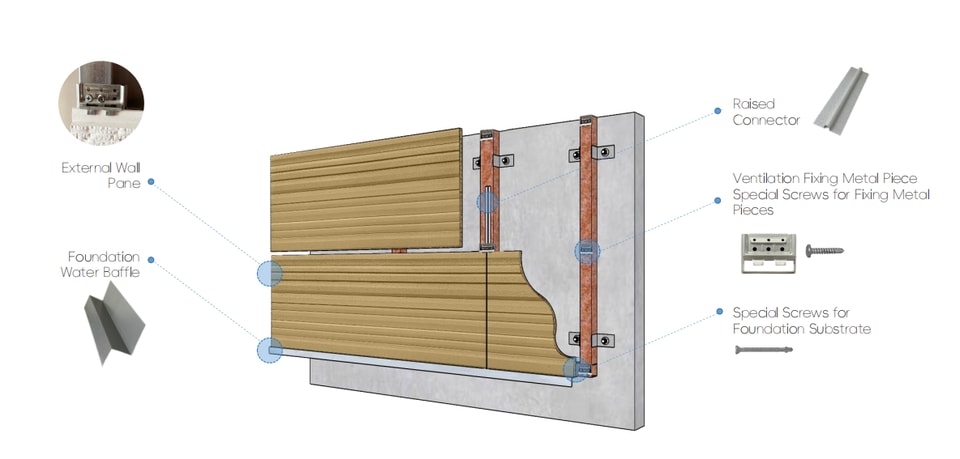
Good cement board installation begins before fastening the first sheet. Verify the approved framing, attachment method, joint treatment, and finish requirements for the exact product. Exterior systems also need details that account for openings and weather exposure during construction.
Use this planning checklist with your installer:
1. Confirm the application. Obtain documentation approving the board for your intended exterior finish, rather than relying on a general “moisture-resistant” description.
2. Plan water management. Identify the barrier, flashing, and drainage details before covering the wall.
3. Follow the fastening schedule. Use the specified fasteners and spacing for the selected assembly; do not borrow instructions from another board.
4. Treat joints correctly. Use the required exterior reinforcement and compatible mortar or basecoat. Joint details differ between tile, thin brick, and textured finishes.
5. Schedule finishing around weather. Follow restrictions on wet or frozen boards, application temperatures, and protection while finishes cure.
Do not read permission for temporary exposure as approval for permanent exposure. If a supplier says the board tolerates weather during construction, ask how many days of uncovered exposure that covers and get the figure in writing. When you plan around a delay, work from the product’s own installation document.
Cutting deserves its own safety plan. Fiber cement cutting can generate silica-containing dust, so follow the manufacturer’s cutting guidance and applicable exposure controls. Use appropriate dust collection rather than assuming working outdoors alone provides adequate protection.
When should you choose fiber cement exterior wall panels?
Choose fiber cement exterior wall panels when you want the panel itself to provide the finished cladding rather than serve as backing for another material. Fiber cement combines cement, sand, cellulose fibers, water, and product-specific additives. Purpose-made siding products offer exterior finishes and profiles without requiring a separate tile or brick surface.
When comparing a cement siding board with backer board, ask for the siding product’s own installation instructions. For searches such as “siding panels 4x8,” treat dimensions as only one filter: confirm exterior use, finish requirements, and attachment details before ordering. A sheet’s size does not establish its role in the wall.
Environmental benefits need product-specific evidence
Fiber cement exterior wall panels are sometimes presented as a new type of environmentally friendly material. More accurately, they are an established material category with ongoing manufacturing improvements. Their environmental appeal can include durability, potentially fewer replacement cycles, and manufacturing practices that recover water or reduce production waste. These benefits depend on the manufacturer and product—not simply the words “fiber cement.”
Look for a product-specific Environmental Product Declaration, or EPD, when evaluating those claims. An EPD provides verified life-cycle environmental information; it is not proof that every fiber cement panel outperforms every alternative. Compare documented impacts alongside expected service life, maintenance, and your project’s requirements.
The takeaway: choose the system, not just the board
For a cement board exterior project, first establish whether you need backing or finished siding. Then verify exterior approval, water management, and compatible installation details. The reliable answer is yes—but only when the particular board and complete assembly match the job.
Contact Us