
Cement Board vs Fiber Cement Siding: What Actually Goes Outside
Can You Use Cement Board Outside?
Yes, you can use cement board outside when the specific product is approved for your application and installed as part of a suitable exterior system. Some boards provide a base for tile or other finishes, while fiber cement siding is designed to serve as exterior cladding. Understanding that distinction helps you choose the right material and avoid treating a backer board as finished siding.
Which cement boards can be used outdoors?
Cement boards approved by their manufacturers for exterior applications can be used outdoors within their stated limitations. Approval applies to the exact product and assembly, not to every board that contains cement. Two boards that look identical can differ sharply in density, water absorption and freeze-thaw resistance, and those measured values, not the category name, decide whether a wall is still sound in its tenth winter.
When comparing exterior building materials, separate these three roles:
Material | Intended role | What to verify |
Exterior-approved cement backer board | Substrate beneath a compatible finish | Approved finish, framing, fastening, and exposure limitations |
Fiber cement siding | Finished exterior cladding | Climate suitability, clearances, flashing, and coating requirements |
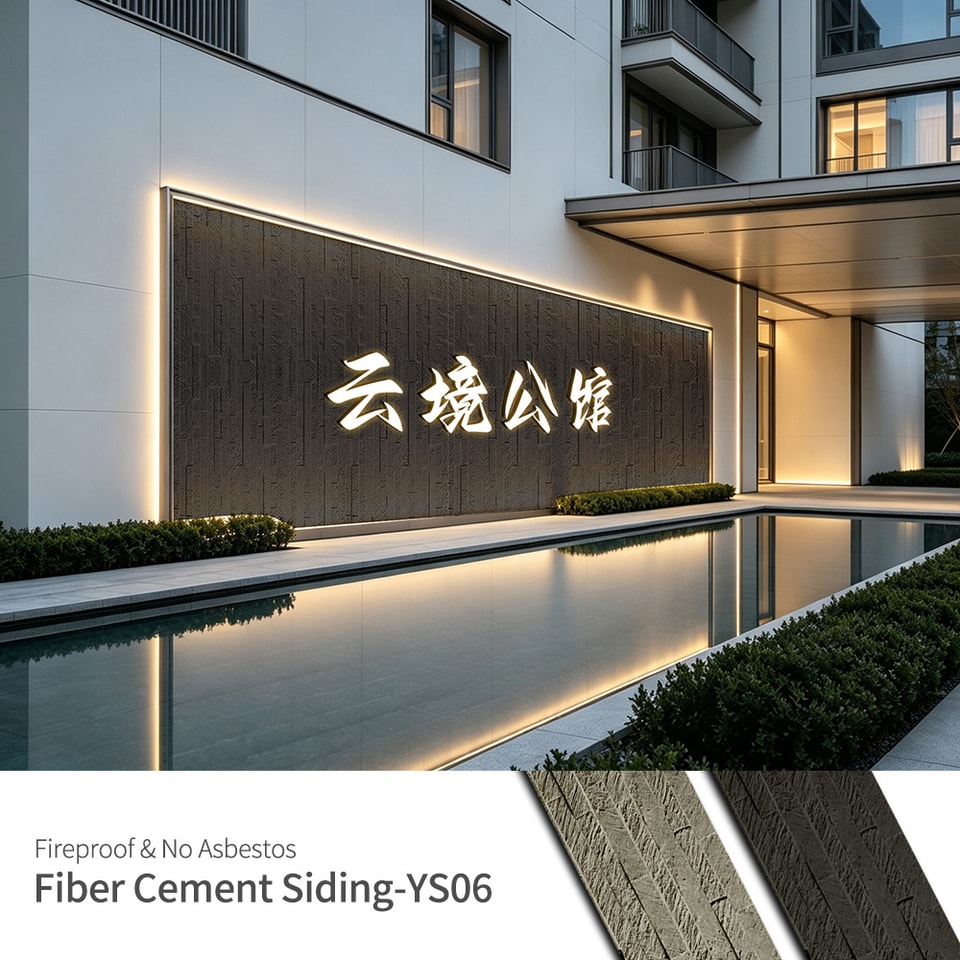
Architectural fiber cement facade panels | Exterior panels within a specified facade system | Subframing, joints, drainage, and attachment details |
These categories are not interchangeable installation systems. A backer board carries a finish, a cladding panel is the finish, and a rainscreen assembly adds a drained cavity and a subframe with its own detailing rules.
Start with the product name printed on the board or packaging. Then find its exterior installation instructions before buying fasteners, coatings, or waterproofing products. This is more reliable than choosing by appearance or relying on the general description “cement board.”
Is cement board waterproof outside?
Ordinary cement backer board should not automatically be treated as a waterproof barrier. A board can tolerate moisture without protecting everything behind it from water. The useful question is not whether the panel survives getting wet, but where the water that reaches the wall behind it is designed to go.
The practical distinction is simple: water resistance describes the board, waterproofing describes a function inside the assembly. In third-party immersion testing of our 16 mm board, no damp mark or droplet appeared on the back face after 24 hours, while water absorption measured 16.5%. Water does not pass through the panel, but the panel still takes up moisture from driving rain. The water-resistive barrier, flashing and drainage cavity are not backup for a leaking board; they handle the water that arrives at joints and fixings. Tile, grout or a decorative finish never replaces those details.
A useful planning exercise is to trace water from the top of the wall to the bottom. Ask how it passes windows, penetrations, horizontal transitions, and the wall base. Have the installer explain the intended drainage route rather than simply promising to seal every joint.
What determines cement board durability outdoors?
Cement board durability outdoors depends on product suitability, attachment, exposure, and the complete finish system. Moisture resistance alone does not establish suitability for every location, and a figure without its test method says little.
For exposed cladding, fiber cement siding durability should be judged on measured values rather than adjectives. Independent testing of the same panel recorded an apparent density of 1.22 g/cm³ and a saturated flexural strength of 8.6 MPa, with no delamination or spalling after 100 freeze-thaw cycles. Humidity deformation of 0.05% and post-absorption warp of 0.06 mm are what tell you whether a board keeps a flat face and tight joints through wet seasons.
Temporary exposure during construction is a separate question from service life. An installation will be weather exposed before the finish goes on, and how long a particular board tolerates that is set by the manufacturer of that board. Ask for the allowance in writing instead of assuming it, and never transfer one supplier’s figure to another’s product.
When comparing outdoor building materials, ask for documented performance relevant to your location. A rainy wall, a coastal exposure, and a freeze-thaw environment deserve more specific discussion than a general claim that a panel is “weatherproof.”
Cement board installation starts with the whole assembly
Successful cement board installation begins before the first panel is fastened. The board, framing, finish, joints, and moisture-control layers must work together. Use the following sequence as a planning checklist, not as a replacement for the selected product’s instructions.
1. Confirm the exact application. Identify whether the board will support tile, thin brick, an approved exterior coating, or function as purpose-made cladding. Finish compatibility is defined product by product, and most cement boards are not structural panels: the framing behind them carries the load.
2. Resolve framing and attachment. Check required supports, panel layout, fastener type, and fastening schedule. Facade panel instructions normally specify framing alignment, stud attachment and joint locations in the same document; do not substitute a fastening pattern taken from a different product.
3. Plan drainage and transitions. Identify the water-resistive barrier, flashing, and treatment around openings before covering the wall. A drained facade assembly may also require a dedicated rainscreen support system with a specified cavity depth.
4. Specify joints and clearances. Obtain the applicable details for panel edges, trim, and adjoining surfaces. Movement allowance and open-joint detailing belong on the drawing, not in a decision taken on the last day of fixing.
5. Prepare a safe cutting method. Cutting, drilling or sanding cement-containing products generates respirable crystalline silica dust. Follow the manufacturer’s cutting instructions, use dust suppression or extraction, and wear approved respiratory protection; working outdoors is not a substitute for dust control.
Match outdoor cement board projects to the right product
For cement board projects with tile or thin-brick finishes, an exterior-approved backer board can provide the specified substrate. Confirm that both the board manufacturer and the finish-system supplier support the proposed assembly. Approval for one finish does not automatically cover another.
For a house exterior where the board itself remains visible, start with purpose-made fiber cement siding or facade panels. Fiber cement board and batten siding creates a vertical appearance using siding and trim components; it should be planned as a siding system, not improvised from unfinished tile backer board.
Describe your project by its actual exposure and intended finish when contacting technical support. “Exterior tiled wall” provides a better starting point than “outdoor cement board.” Include a sketch showing openings, adjoining surfaces, and where water will drain.
Evaluate exterior facade panel claims separately
For facade panels marketed as “E0 eco-friendly,” “waterproof,” “fireproof” and “self-cleaning,” request evidence for each property separately. They are four claims, not one package.
· E0 eco-friendly: Ask which emissions standard and which test report support the designation. E0 belongs to formaldehyde-emission classifications for wood-based panels; a cement board uses no such resin system, so the label is either meaningless here or borrowed from another product category. On asbestos, our board was tested to AS 5370 and returned negative for all six regulated fiber types.
· Waterproof: Clarify whether the claim describes the panel, a coating, or a tested assembly, and ask for the method behind it. A credible answer gives an immersion or penetration result and states the absorption figure beside it, because absorption is what determines how the wall behaves once it has rained for a week.
· Fireproof: Request the classification and the standard it was issued against, because the bare word proves nothing. Our panel was tested to AS 1530.1 and deemed noncombustible, and to AS/NZS 1530.3 with a spread-of-flame index of 0 and a smoke index of 5. That is a material result under Australian test methods, not an EN 13501-1 class and not a finished wall-system rating; site-applied paints also alter how a surface responds to flame.
· Self-cleaning: Ask what mechanism produces the effect and what maintenance it assumes, because it is a surface finish rather than a property of cement. Our coated board reached Grade 0 stain resistance and withstood 10,000 scrub cycles without breaking through, so rain rinses the face more evenly than a porous surface would; that is a measured cleanability claim, not a claim that any panel cleans itself.
Keep maintenance practical
Durable exterior cladding still needs appropriate care. Low-pressure water with a soft brush is normally sufficient, while sustained pressure washing can drive water into joints and damage a factory finish. Use the care instructions for the product you actually bought rather than assuming every cement-based surface tolerates the same cleaning method.
Keep the installation guide, finish details, and warranty documents together. When inspecting or arranging repairs, share those records with the contractor. They provide a better starting point than guessing which sealant, patch, or coating was originally used.
The takeaway
Cement board can be suitable outside, but choose by documented application—not by material name alone. Distinguish backer board from finished cladding, establish the water-management details, and verify the complete installation system before purchasing. That approach turns a broad material question into a practical project plan.
References
Contact Us