
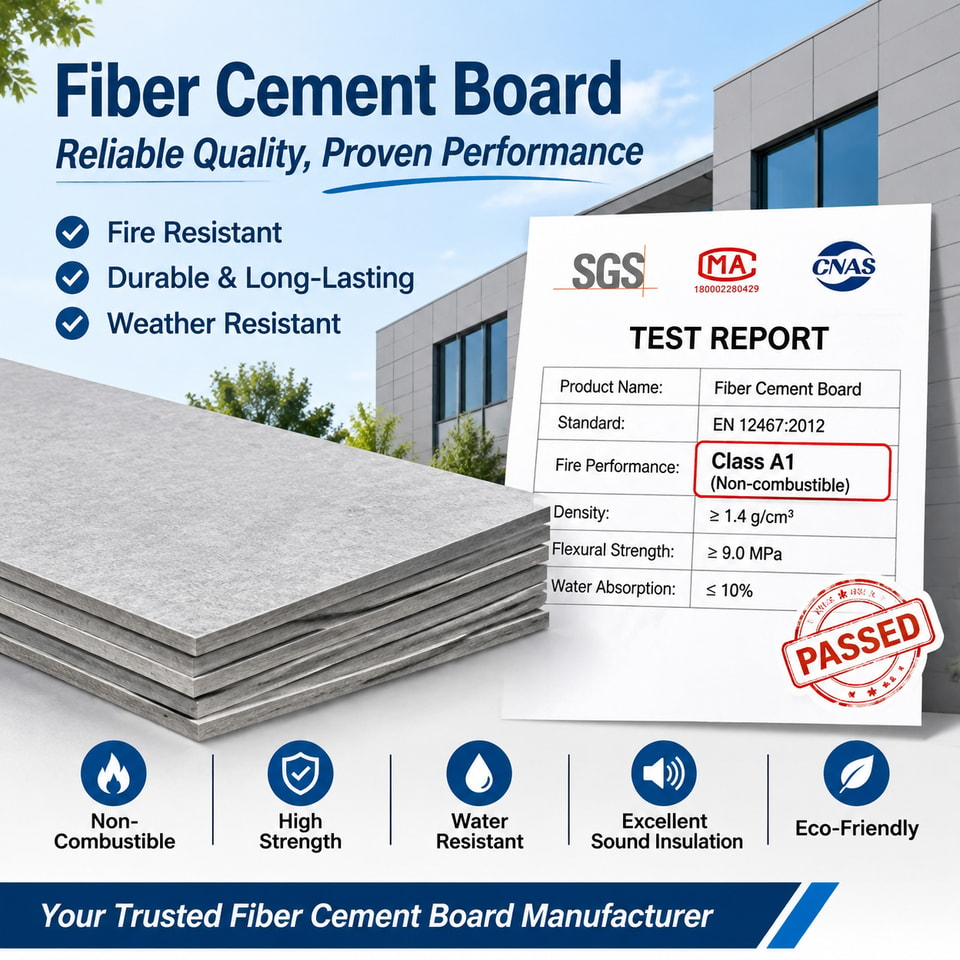
Fiber Cement Board Fire Resistance and Asbestos Tests
Fiber Cement Board Fire Resistance: What the Test Reports Actually Say
Buyers ask about fire in two ways. The first is whether the board burns. The second is whether it contains asbestos. Both are reasonable questions about a mineral panel installed on buildings people sleep in, and both can be answered with a document rather than an adjective.
We hold three SGS reports on our fiber cement board. This page sets out what each one tested, what the numbers mean, and where the limits are.
Three different questions, often confused
"Fire resistance" covers three separate assessments, and suppliers blur them because the blurring flatters the product.
Noncombustibility asks whether the material sustains flaming. It is a small-specimen furnace test with a yes or no answer.
Fire resistance rating asks how long an assembly holds back fire, measured in minutes against stability, integrity and insulation. It belongs to the wall build-up, not the panel. A rating written as −/60/60 describes an assembly.
Reaction to fire classification is the European scale from A1 to F. A1 is not the same certificate as an Australian noncombustibility result, even when both describe a board that will not burn.
A supplier who answers "our board is fireproof" has answered none of the three. Fireproof is not a classification in any standard we test against.
The practical consequence: a tender document that asks for a "fireproof board" cannot be answered properly. What it usually means is noncombustible material plus a rated assembly, and those are two submissions, often from two parties. Ask which one the project actually needs before you price it.
The noncombustibility test: AS 1530.1:2024
Our report is SGS AJFTS25007286R01_EN, issued 4 November 2025. Five specimens were conditioned at 60 °C for 20 to 24 hours, cooled in a desiccator, and tested for 30 minutes each.
| Parameter | Result | Failure threshold |
|---|---|---|
| Sustained flaming | 0 s on all five | Any flaming fails |
| Furnace temperature rise, ΔTf | 2.6 °C | Above 50 °C fails |
| Specimen centre rise, ΔTc | 4.0 °C | — |
| Specimen surface rise, ΔTs | 6.4 °C | Above 50 °C fails |
| Mass loss | 38.4% | — |
| Observations | None | — |
The conclusion is stated on the report: the tested sample shall be deemed Noncombustible.
Two numbers matter. Zero seconds of flaming across five specimens means the board contributed no fuel to its own test. And a surface rise of 6.4 °C against a 50 °C threshold is not a marginal pass, which is what you expect from a cement-based product with no organic binder to burn.
The 38.4% mass loss looks alarming until you know what it measures. The furnace drives off chemically bound water from the cement matrix, and that release is the mechanism keeping the surface cool. A board that loses nothing has nothing to give up, and would heat faster.
The flame spread and smoke test: AS/NZS 1530.3:1999
Our second report is SGS AJFTS25006840R01_EN, issued 17 October 2025. Six specimens of 600 × 450 mm were tested, mounted on a fibre-reinforced cement substrate.
| Regulatory index | Result | Range |
|---|---|---|
| Ignitability | 0 | 0 to 20 |
| Spread of flame | 0 | 0 to 10 |
| Heat evolved | 0 | 0 to 10 |
| Smoke developed | 5 | 0 to 10 |
Three zeros are the best possible result, and those are the three to quote. The specimens did not ignite: zero of six, recorded as NI for ignition time.
The smoke index is 5, mid-scale, and we will not describe it as low smoke. On a scale where 0 is best, 5 means moderate. For an external facade that is rarely the governing number, because the wall sits outside the escape route. For a soffit, canopy or interior lining it feeds the egress calculation, and your fire engineer needs the real figure, not a rounded one.
The report also notes the specimens discoloured. That is normal for a coated cement board under radiant heat, and it is recorded as an observation, not a failure.
What these reports do not cover
A test report describes a specimen, not a building. Four things sit outside these documents and each one gets asked about eventually.
No fire resistance rating. We have not tested a complete wall to AS 1530.4 or BS 476 Part 22, so there is no −/60/60 figure. If a project needs one, it comes from testing the full build-up: substrate, cavity and fixings.
No European classification. AS 1530.1 noncombustibility does not convert into EN 13501-1 A1 or A2. Separate tests, separate specimens. If your market needs a Euroclass, the board has to be submitted for it.
No US classification. ASTM E84 and E136 have not been run.
Nothing on the coating as a separate component. The reports cover the board as supplied. A site-applied coating changes the surface, and a fire engineer may ask what it contributes.
None of this weakens the product. It makes the paperwork usable, because a specifier needs to know which numbers exist and which do not.
Does fiber cement board contain asbestos?
No, in our product, and it is documented rather than asserted.
Our third report is SGS SHAIN26003172701, issued 6 February 2026, by polarised light microscopy to AS 5370:2024 with Amendment 1:2025. Six asbestos minerals were looked for individually at a detection limit of 0.1% by weight.
| Asbestos type | Result |
|---|---|
| Chrysotile | Not detected |
| Actinolite | Not detected |
| Tremolite | Not detected |
| Amosite | Not detected |
| Anthophyllite | Not detected |
| Crocidolite | Not detected |
No unknown mineral fibres were reported either, and the document carries CNAS accreditation L0599 with the ILAC-MRA mark. That is the mark to look for if the result has to survive a tender review.
The history explains the question. Fiber cement as a category was made with asbestos in some markets until the 1980s, and buildings being re-clad may still carry asbestos cement sheets. Modern fiber cement uses cellulose fibre, silica and cement. A supplier should produce a named, dated report with the method and detection limit stated, not a certificate reading "asbestos free" with nothing behind it.
"Not detected" is the precise claim: nothing found above 0.1%. A supplier claiming absolute zero is overstating what a microscope test can prove.
Siding, cladding, exterior wall: one board, three words
The vocabulary confuses buyers more than the technology. Fiber cement board siding is the North American term for a board forming the finished face, usually in a lap or panel profile. Fiber cement board cladding is the British and Australian term for the same role, including ventilated facades where the panel sits on a subframe with a drained cavity. Fiber cement board for exterior wall is the plain description covering both.
What matters is not the word but the system. Our panel, 3030 × 455 × 16 mm with a textured face, is one component of a dry-hung ventilated facade, and the fire behaviour of that facade depends on what is behind the panel, whether the cavity runs continuously, and whether the local code requires cavity barriers at floor lines.
A noncombustible panel in an assembly with combustible insulation and no cavity barrier is a fire problem wearing a good test report. That is where specifications are won and lost.
Installation details that change the fire answer
Fiber cement board installation is where fire performance is either kept or lost, and none of the reports say anything about fixing. Three site habits quietly change the outcome.
Penetrations come first. Every pipe, bracket and cable through the facade interrupts the panel line, and each has to be detailed and, where the code requires, sealed with a tested product rather than mastic.
Joints come second. An open joint is a designed gap in a drained facade, and also a path. Where the wall must resist fire spread through the cavity, joint and cavity details come from the fire strategy, not from the installer's habit.
The substrate comes third. The tests above ran on a board, some with a cement substrate behind it. A timber frame behind the same panel is a different assembly with its own fire story.
The full sequence is in dry-hung fiber cement cladding installation, and the component sizes in fiber cement cladding accessories.
What to ask a supplier
Five questions, each with a document behind it:
- Which standard was the noncombustibility test run to, and what conclusion is printed on the report?
- What are all four regulatory indices, quoted individually? A supplier quoting only the three zeros has not read the fourth line.
- Is there a rating for a complete assembly, and if so for which build-up?
- Which asbestos method, which laboratory, which detection limit, and is that laboratory accredited?
- Which standards have not been tested? The gaps tell you more about a supplier than the passes.
The fifth question is the one that sorts suppliers. Anyone can send a passing certificate. A supplier who can list what has not been tested, in writing, has read their own reports and knows where the product stops. That is also the supplier least likely to leave you negotiating with a building surveyor after the panels are on the wall.
Ask in writing and keep the answer on file. Fire documentation is requested at tender, at building approval and again at handover, often by three different people who have never spoken to each other.
FAQ
Is fiber cement board fireproof? No material is fireproof in the absolute sense. Our board is classified Noncombustible to AS 1530.1:2024, meaning it does not sustain flaming; the tested specimens recorded zero seconds of flaming.
Does fiber cement board contain asbestos? Modern fiber cement does not. Our board was tested by PLM to AS 5370:2024 and all six regulated asbestos minerals were not detected at a 0.1% limit. Fiber cement installed before the 1980s may contain asbestos and should be tested before removal.
What is the fire rating of fiber cement board? The board carries a noncombustibility classification, not a fire resistance rating. A rating in minutes applies to a complete wall assembly and requires the full build-up to be tested.
Can fiber cement board be used on a high-rise facade? That depends on the building's fire strategy, not the panel alone. Noncombustibility helps, but cavity barriers, insulation choice and the substrate decide whether the assembly is acceptable.
Is a smoke index of 5 a problem? For an external facade it is usually not the governing number. For soffits, canopies and interior linings, smoke development feeds the egress calculation and should be given to the fire engineer as 5, not called low.
Contact Us