
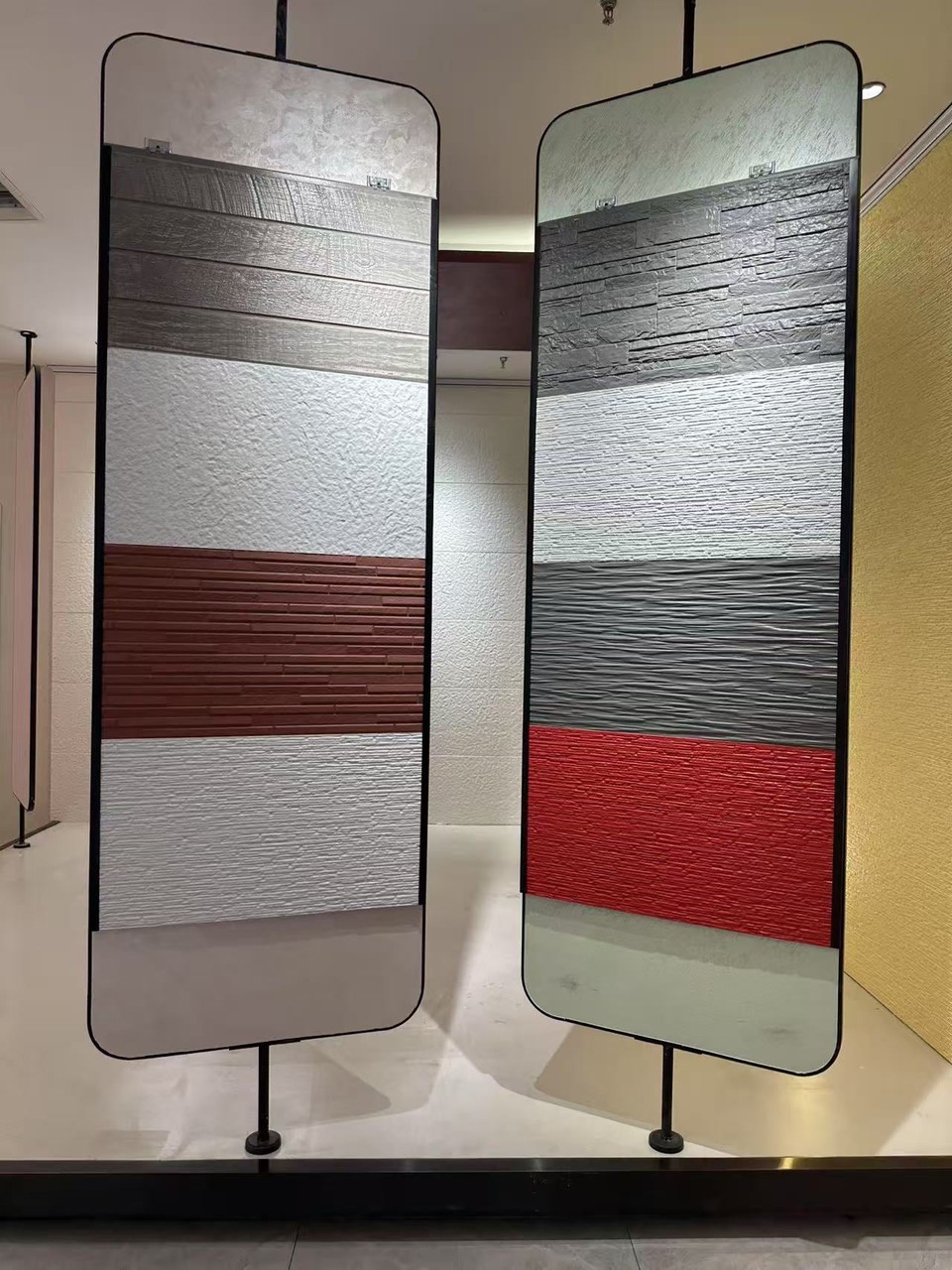
Fiber Cement Board Styles: Wood Look, Linear, Brick
Best-Selling Fiber Cement Board Styles: Wood Grain, Linear, Brick
Walk into any building materials & supplies catalogue and the fiber cement pages look the same: a stack of flat grey sheets, a thickness list, a price per square meter. That is the commodity end of the market, and it is where every new supplier starts competing on cents.
The panels that actually sell in volume are the textured ones, because they answer a question the flat board cannot: what will this wall look like. A buyer choosing fiber cement for a house is not buying cement. They are buying timber that does not rot, brick that does not need a lintel, and a facade that still looks right in year ten.
Three textures do most of that work. Here is what each one is for, how it is made, and what to check before you order a container.
Why texture is the commercial decision, not the finish
A flat exterior fiber cement board competes with every other flat board in Asia. A textured panel competes with timber cladding, brick slips, stone and composite — categories where the installed price is several times higher and the buyer is already expecting to pay for appearance.
That changes the sale. On flat board the conversation is price per square meter. On textured board it is what the facade looks like, how it ages, and whether the texture reads as real from three metres away.
Across fiber cement building materials ranges, texture is also the only line a buyer can judge without a specification sheet. Colour chips can be printed; depth cannot.
It also changes what can go wrong. A flat panel that fades is a warranty claim. A wood-grain panel whose grain depth is too shallow looks like painted plastic, and no amount of coating quality rescues it — the mould, not the paint, decides that.
Our panels are 3,030 × 455 × 16 mm with the texture formed into the face and sealed under the factory coating. One press, three mould sets, one core formulation. The core does not change between styles; only the face does.
Wood look fiber cement siding: the volume seller
Wood look fiber cement siding is the single largest category in this product family, and the reason is simple. Timber cladding has three problems that owners accept until they have to pay for them: repainting every few years, rot at the base and around fixings, and fire performance.
Fiber cement removes all three. The grain is pressed into the face, so there is no repainting cycle to restore a grain that was never paint. It does not rot, so the base detail that destroys timber cladding in wet climates is no longer the failure point. And on fire, the panel is classified Noncombustible to AS 1530.1:2024, which is a different conversation from timber entirely.
Two checks separate a good wood-grain panel from a bad one.
Grain depth, not grain pattern. A deep mould costs more to make and wears faster, which is why cheap panels use shallow grain with strong colour contrast to fake depth. Stand three metres away: shallow grain flattens into a single tone and the wall reads as painted board.
Batch-to-batch colour. Texture hides a lot, but a wood colour that shifts between containers shows on a wall where panels sit side by side. Ask for a colour tolerance in writing and approve the sample outdoors.
Wood grain suits residential work, low-rise commercial, and any facade where the client wanted timber and the budget or the fire code said no. See the wood grain range for current faces.
Linear and striped profiles: the shadow-line workhorse
The linear face — narrow parallel grooves, sometimes called batten or striped — does something the other two cannot: it controls how the wall reads at distance.
Shadow lines break up a large flat elevation. On a building where a single texture across 40 metres would look like a warehouse, a linear face gives scale and rhythm without adding a second material. It is also the most forgiving face for a facade with many openings, because the eye follows the lines rather than the interruptions.
Two design points matter more than the profile itself.
Direction. Our panel is 3,030 × 455, so horizontal lines come free with the course and vertical lines require the panel to be rotated — which changes the module and the fixing pattern. Decide direction at drawing stage, not on site.
Line spacing versus panel module. If the groove spacing does not divide cleanly into 455 mm, the lines will not continue across a horizontal joint, and the whole facade looks stitched. This is the first thing a good installer checks and the first thing a cheap supplier gets wrong.
Linear faces suit commercial elevations, boundary walls, stair cores and any building where the facade needs to look longer or taller than it is.
Brick pattern: the renovation and residential face
Brick pattern is the fastest-growing of the three, largely because of renovation work.
A building that cannot take the weight of real brick, or cannot justify the cost of brick slips, can still have a brick facade. The panel goes onto a dry-hung system, so the existing wall carries almost nothing extra, and the work happens without scaffolding the whole elevation for months.
The honest caveat: the panel's joint grid is not a brick bond. Real brick has a running bond with alternating courses, and a panel has a repeating pattern stamped to a fixed module. From across the street it reads correctly. From one metre, a bricklayer can tell. Say that to the client before they order, not after the panels are up.
Second caveat: at corners and openings, the pattern has to be cut, and a cut brick pattern looks exactly like a cut brick pattern. That is why our corner profiles exist — wrapping the corner with a matching profile is the difference between a facade and a patch job.
Brick suits housing, low-rise residential, extensions, and any project where the surrounding buildings are brick and a modern panel would look out of place.
Stone grain: the fourth face worth mentioning
Stone grain sits outside the three requested styles but sells alongside them, usually on the same building.
It carries the same advantages — no weight, no fixing into masonry, no efflorescence from a real stone bed — and it solves a specific problem: a client who wants stone on the entrance elevation but not on the other three, and cannot justify the cost of two systems. One panel family, two faces, one fixing detail. The stone grain range covers the current patterns.
One warning specific to stone. Because stone grain imitates a material with visible depth, shallow moulding shows immediately: a stone face without relief has the flatness of printed vinyl, and the illusion collapses at about two metres. If a client is comparing against real stone, show them the panel at that distance, not across a showroom. Stone also reads darker than wood at the same colour value, which matters on a north elevation where the wall is already in shade for most of the day.
Choosing between them
Three questions, in this order.
What is the building next to? A fiber cement house in a street of brick looks like a mistake, and a brick panel in a street of render looks like a try-hard. Match the neighbours, then differentiate with colour.
How close will people get? Texture that reads at three metres is enough for a facade. Texture that will be touched needs deep grain and a consistent batch, because hands find every variation.
What does the climate do to it? Wet, driving-rain climates reward deep texture, because the surface water sheds from the high points and dries faster. Hot, dusty climates punish pale flat faces and reward darker textured ones.
There is a fourth question, and it is the one buyers forget: how will this facade be photographed? Almost every project now appears on the builder's website and in the client's listing. A linear face photographs as rhythm and a wood grain photographs as material; a flat panel photographs as a blank wall, whatever its technical specification. If the buyer sells on appearance, the texture is part of the marketing, not a line item.
How to buy: approve a sample the way the wall will see it
The single most common quality dispute in textured cladding is not a defect. It is a sample approved indoors, under factory light, held in the hand, and compared against a finished wall 6 metres away in daylight.
Ask for three things before the order.
A sample with the same texture depth as production, not a smooth-faced colour chip. A colour tolerance stated in writing, with the measured value rather than the word "consistent". And two samples from different batches, so you know what variation to expect instead of discovering it at the second container.
Then do the test that costs nothing. Fix the three samples to a board, take them outside, and look at them from three metres and from ten, in morning light and in shade. A face that survives that comparison will survive the site. A face that only looks right in the hand does not, and no specification clause will fix it afterwards.
If the order mixes styles, ask which faces share a coating batch. Three textures from one production run will match each other far better than three textures pulled from different runs, and on a facade where wood grain sits beside stone, that difference is visible from the street.
FAQ
Which fiber cement board style sells the most? Wood look fiber cement siding, by a wide margin, followed by linear profiles and then brick pattern. Wood grain carries the largest residential demand because it replaces timber cladding.
Can the same panel be supplied in different textures? Yes. The core, thickness and dimensions stay the same at 3,030 × 455 × 16 mm; the texture is set by the mould, so one order can mix faces as long as each is specified by style.
Is wood look fiber cement siding suitable for a full house facade? Yes, on a dry-hung ventilated system. It is used for complete elevations as well as gables and feature walls, and the panel is classified Noncombustible to AS 1530.1:2024.
Does a brick pattern panel match real brick dimensions? It reads as brick from a normal viewing distance, but the joint grid is a fixed repeating pattern rather than a running bond. Tell the client before ordering, particularly on a building where bricklayers will see it close up.
How many styles can go in one container? As many as the order needs. A mixed container across three or four textures is the usual first order, since it costs little more per square meter and shows which face the market actually buys.
Contact Us