
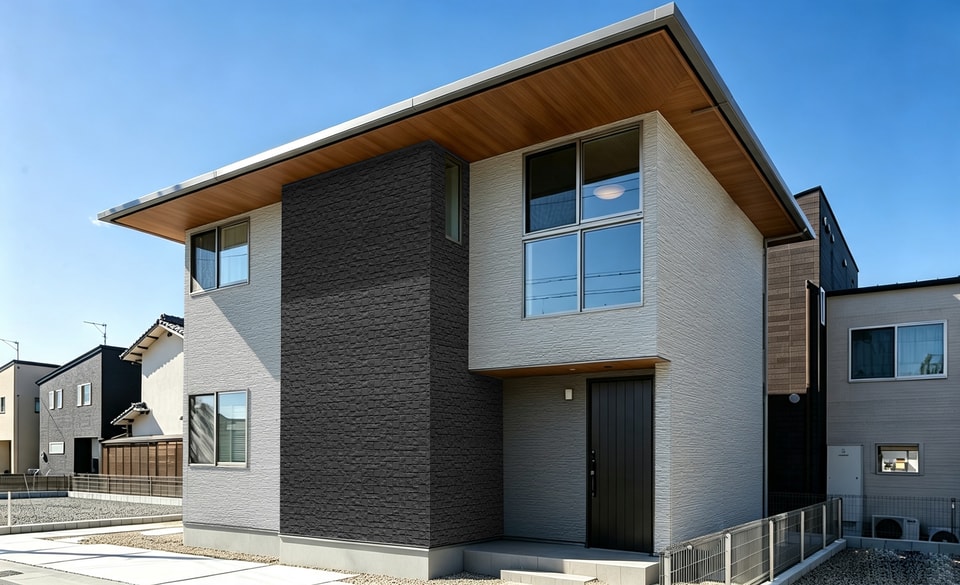
Cement Board for Exterior Applications | Shengbaoqiang
Cement Board for Exterior Applications
Cement board is a category name, not a specification. Under that name you can buy a tile backer, a soffit lining, a balcony substrate and a decorative facade panel, and the four are not interchangeable outdoors. What separates them is not the cement, it is the role each one plays in a wall.
This guide covers the exterior roles and the four decisions that actually change cost and service life: coating, joint treatment, texture and supplier. Where a question is a simple yes or no, it is answered elsewhere and linked.
Two exterior roles, and why they are confused
Fiber cement board outdoor work splits into two roles, and almost every expensive mistake in this category comes from treating them as one.
A substrate carries a finish. Tile backer on a balcony, a carrier board behind render, a lining under a membrane. It is exterior-rated because it tolerates weather during construction and will not rot, not because its face is meant to be looked at.
A facade panel is the finish. In fiber cement cladding systems it forms the visible skin, carries a factory coating, and sits on a drained cavity. Its face is the product.
The consequences run in opposite directions. A substrate is judged on adhesion and flatness; a facade panel on coating durability, joint design and wind load. Buying one for the other's job is the most expensive mistake in this category, and it surfaces after the wall is closed.
Whether cement board can be used outdoors at all is a shorter question, answered in can cement board be used outside. This page assumes yes and moves to which board, at what cost, for how long.
The panel we make for exterior walls
Our exterior product is a decorative fiber cement board for exterior wall cladding: 3030 × 455 × 16 mm, textured face, supplied for dry-hung ventilated facades. Each panel covers 1.379 m².
The 3,030 mm length runs horizontally, so the 455 mm edge sets the course height and a 10 m elevation works out at 22 courses. One horizontal joint line per course, no vertical grid to lay out, which is where most of the labour saving sits.
The 16 mm section has a reason. Stiffness rises with the cube of thickness, so 16 mm is roughly eight times stiffer than 8 mm at the same span. A stiffer panel spans further between fixings, needs fewer rails, and resists the oil-canning that shows on thin boards under raking light.
Six textures: wood grain, stone grain, brick pattern, striped, flat, and a wood wool acoustic face. All formed in the panel and sealed under the factory coating.
What drives the cost of fiber cement siding
Cost fiber cement siding is the query where buyers get the worst answers, because most suppliers quote one number: price per square meter of panel. That number is not the cost of a facade.
The panel, with the wastage factor for cuts at openings and corners.
The accessories. Corners, snap joints, dowel bars, apron flashing and fixings are a small share of the package and the part that cannot be bought locally at short notice. A quotation listing only panels is incomplete, not cheaper.
The subframe, driven by rail spacing. At 500 mm centres a 10 m wide elevation takes 21 vertical rails.
Labour, which depends on panel size and weight. A 3,030 mm panel two people lift is a different rate from a board needing a hoist.
Freight, charged by volume rather than weight, so pallet packing density matters as much as unit price.
Coating and colour, if the specification falls outside the standard range.
Ask for a quotation against a drawing and a take-off. Two suppliers quoting the same headline panel price can differ by a third on the installed square meter, and you will not see it until the accessories invoice arrives.
How long fiber cement board lasts outdoors
Fiber cement board lifespan is usually quoted as one number, which is misleading. The board is mineral and does not rot; the number that matters is how long the system keeps it that way.
The coating. Our board holds Grade 0 stain resistance to GB/T 9780-2013 by the immersion method, survives 10,000 scrub cycles to GB/T 9266-2009 with no substrate exposure, and 96 hours in saturated calcium hydroxide to GB/T 9265-2009 without blistering, flaking or softening. A failing coating ends a facade's appearance long before the board gives up.
The cavity. A dry-hung panel on a drained, ventilated cavity dries after rain. The same panel fixed tight to a wall stays wet at the back.
The fixings. Coastal work needs a grade that outlasts the coating. A2 and A4 are both stainless and are not equivalent in salt air.
Maintenance. Washing removes the dirt that feeds biological growth. A facade never washed looks older than its board.
Our panels also pass 100 freeze-thaw cycles to GB/T 7019-2024 with no delamination or flaking. That is a laboratory result, and in service it only holds if water can drain and the panel can dry.
Primer: the decision most projects get wrong
Fiber cement board primer is where a good facade is quietly lost, because primer is invisible and the first place water enters is a cut edge that was never sealed.
Two primers, and they are not substitutes. Factory primer goes onto the panel face on our own spray line, before the finish coat, in a controlled booth rather than on a scaffold. That order matters: the primer is what bonds to the alkaline core, and applying it in-line gives a consistent film across the whole face instead of a coat that depends on who held the roller. Site primer is then only for what the line did not cover: cut edges, drilled holes, notches, any field modification. A cut edge exposes the raw core, which absorbs water faster than the face.
This is where an in-house spray line separates a manufacturer from a trader. A trader re-sells board whose primer was applied by whoever pressed it, to a specification you cannot inspect. We spray primer and finish on the same line, under the same batch record.
Two rules prevent most failures. Prime cut edges before the panel goes up, because once fixed you cannot reach the top edge. And specify a primer for alkaline substrates: cement board is alkaline, and a primer that is not alkali-resistant fails at the interface rather than at the surface, which is far harder to diagnose.
For sealing, use neutral-cure silicone rather than acid-cure, which can attack the coating at the bond line.
Joint compound, and when not to use it
Fiber cement board joint compound belongs to flush systems: interior walls, ceilings, smooth facades where joints are taped, filled and sanded to disappear. It is a legitimate material and the wrong one for a drained exterior facade.
Our system is the opposite. Panels are separated by an open joint held by a snap joint, and the cavity drains and vents. Filling those joints closes the drainage path, traps moisture behind the panel, and turns a ventilated facade into a wall that stays wet. The symptom shows months later as efflorescence or a tide mark, and the cause is a tube of filler applied with good intentions.
So the answer depends on the system, not the material. Flush facade with concealed fixings and a sealed face: compound and mesh tape are correct, and the wall behind must be detailed as a sealed assembly. Ventilated rainscreen: the joint is a designed gap and compound has no place in it.
Ask which system your supplier's panel is detailed for before buying the filler. Most joint failures on fiber cement facades are a system mismatch, not bad workmanship.
Texture: what it changes beyond appearance
Fiber cement board texture is sold as a look, and it does more than that.
It hides the joint. A textured face breaks up the line where panels meet, so the joint reads as shadow rather than seam. On a flat panel the same joint is a visible line across the elevation, and any misalignment between courses shows.
It changes dirt behaviour. A deep texture holds rain in the low points, which helps self-cleaning, and holds dust in the same places. On a dusty site, light textures show a pattern within a season.
It costs more to repaint, because coating fills the profile rather than sitting on a flat face. Budget maintenance against the texture, not a generic rate.
It sets the sample process. Approve texture outdoors, on a wall, facing the direction the facade faces. Colour approved indoors is the commonest reason a batch gets rejected on site.
Our six textures are formed in the panel rather than applied as a film, so the pattern cannot peel off as one.
Choosing a fiber cement board supplier
Fiber cement board supplier is a crowded search result and a thin set of real options. Four checks separate a manufacturer from a trader with a catalogue.
One product line. A supplier who makes one panel family knows its limits. A supplier listing every building board in the province is selling, not making.
Named test reports with the standard on them. Our board holds SGS reports to AS 1530.1:2024 (noncombustible), AS/NZS 1530.3:1999 (indices 0/0/0/5) and AS 5370:2024 (asbestos not detected at 0.1%); details are in fiber cement board fire resistance. A supplier who cannot name the standard, the laboratory and the conclusion has not tested anything you can use.
A packing drawing. Panels per pallet, pallets per container, corner protection. This document predicts how much arrives broken.
A factory you can visit. Nantong is two hours from Shanghai Hongqiao. A supplier who discourages the visit has a reason.
FAQ
Can cement board be used for exterior walls? Yes, if the product is designed as a facade panel rather than a substrate, and installed on a drained assembly. An exterior-rated backer board left as the visible face is outside its intended use.
Is fiber cement board waterproof? Water-resistant, not waterproof. It absorbs moisture into its thickness without losing strength or passing water through, but joints, cut edges and fixings still need detailing.
Do exterior fiber cement joints need joint compound? Only on flush, sealed systems. On a ventilated facade the joint is a designed gap that must stay open to drain and vent, and compound blocks it.
How long does fiber cement board last outside? Service life is set by coating, cavity, fixings and maintenance. The board is mineral and does not rot; the system around it decides how long the facade stays sound.
Which is cheaper, flat board or textured panel? Compare installed cost, not panel price. A textured panel removes the need for applied battens or a separate finish layer, which often offsets a higher unit price.
What primer does fiber cement board need outdoors? An alkali-resistant primer on every cut edge and field modification, plus the factory coating on the face. Prime before installation, not after.
Contact Us