
Fiber Cement Cladding Factory Direct: Specs, Supply and What to Check Before You Buy
Most fiber cement cladding enquiries we answer in Nantong start the same way. An architect has drawn a rainscreen facade. A contractor has priced it. The imported panel that was specified comes back at a number the client will not sign, and suddenly everyone is looking for a factory that can match the performance without gambling on the certificate, the fire rating or the shipping date.
We are SBQ (ShengBaoQiang). We make fiber cement exterior cladding in our own plant in Nantong, Jiangsu, and export orders ship FOB from Nantong port. What follows is the information buyers actually ask for in their first two emails: what the panel is made of, what has been tested, how the system installs, how an order moves through production, and where a factory-direct panel genuinely differs from Nichiha, KMEW or James Hardie. If you specify or import facade material, treat this as the checklist version.
Why the asbestos question comes first
We put this at the top of the datasheet for a reason. Asbestos cement was used in cladding for most of the last century, so buyers in Australia, Europe and North America now treat the material name itself as a warning light. Importers have told us their customs brokers ask for the test report before they will even quote duties on a container.
SBQ fiber cement cladding is 100 percent asbestos-free, and we would rather you verified that than believed it. The raw mix is cement, cellulose fibre, silica powder and mica. No asbestos, no formaldehyde, low radiation. An independent SGS laboratory test report is available for tender submissions, customs clearance and project documentation, and we will send the digital copy on request. If your client's specification calls for a physical document in the project file, hard copies can follow by courier.
The same material profile is usually what carries a panel through the environmental section of a green building submission: mineral fillers and cellulose fibre instead of petrochemical binders, and a finished board with no added formaldehyde. If your client is working to a particular green rating system, tell us which one and we will tell you plainly which requirements the panel meets and which are decided by the rest of the wall build-up, not by the cladding.
What an A1 non-combustible rating means on site
Fire performance is where cheap facade material gets found out, and it is the first line most specifiers highlight before they open a price file.
A1 is the top reaction-to-fire classification. A panel in that class does not feed flame spread and releases negligible heat when exposed to fire. For high-rise residential, hotels, schools and other public buildings, that classification is frequently written straight into the specification, which means a supplier without the documentation is not in the conversation at all. In bushfire-prone parts of Australia the requirement tightens further, and the cladding is assessed as part of the whole wall assembly rather than on its own.
One caveat worth stating clearly, because it comes up on almost every project: fire classification is product and build-up specific. If your project needs a certificate for a particular thickness, surface or complete assembly, ask us for the document that matches the panel you are actually ordering, and check it against your local code before sign-off. We would much rather answer that question three weeks before the order than three weeks after it.
The self-clean coating, and what to expect after year five
The surface finish on SBQ panels is a photocatalytic hydrophilic coating. In plain terms: sunlight activates the surface, rainwater spreads into a thin film instead of beading into droplets, and that film carries dust down the face of the panel instead of leaving it to bake into vertical streaks. On a facade that faces a road, an airport or any dusty environment, that is the difference between a building that still looks new at year five and one that is already being scheduled for repainting.
The coating is also what sits behind our colour retention figure. SBQ panels are specified for 15-year colour retention with strong UV resistance, which is the practical answer to the question buyers ask about sunny, high-radiation markets: does the wood grain or the stone tone still read as intended once the building has been through several summers.
We will not tell you the panel is maintenance free, because no exterior cladding is. Runoff still leaves mineral deposits around horizontal trims and in sheltered reveals, and in coastal locations salt spray is worth rinsing off periodically. What the coating changes is frequency. It reduces cleaning cycles and pushes back repainting, and on a large facade that shows up in the maintenance budget rather than in the showroom.
Textures, sizes, and how custom work actually runs
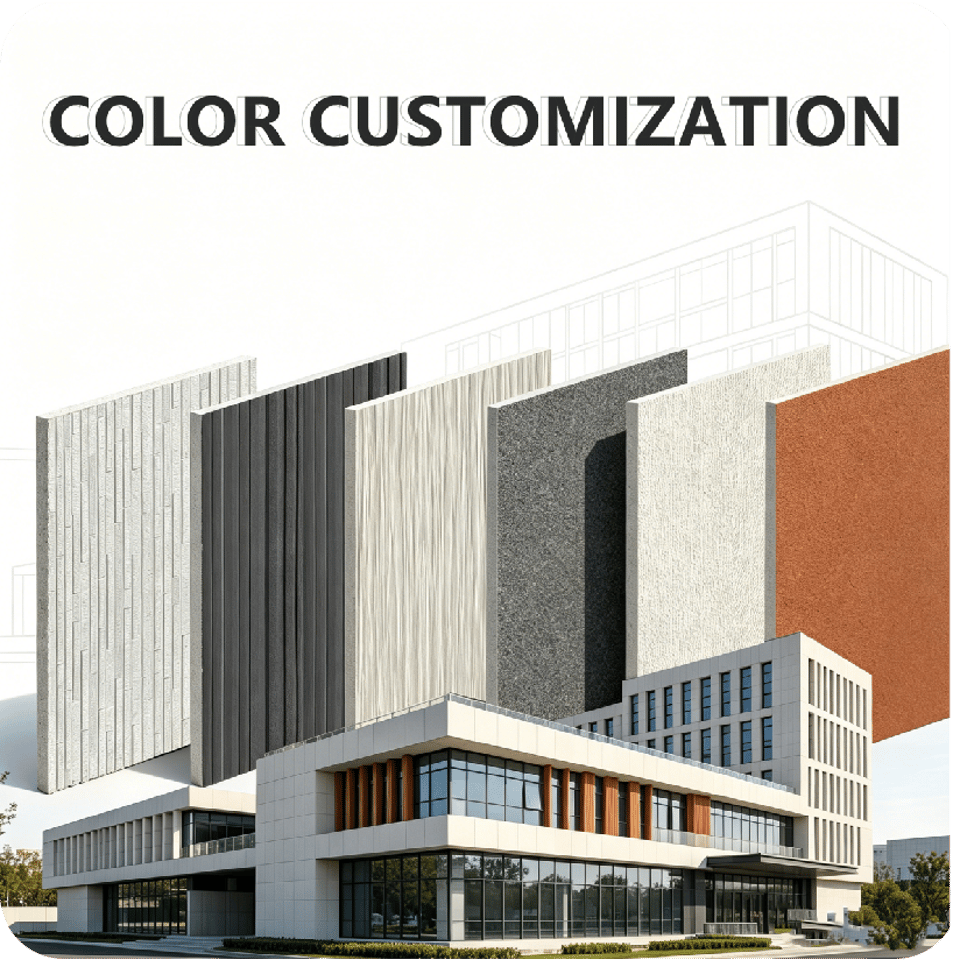
The range covers wood grain, stone texture, brick pattern, linear engraved and plain flat panels, with custom colour matching for project-specific facade design. The standard board is 3030 x 455 mm, in 16 mm and 18 mm thicknesses.
The 16 mm panel in that size is the one we keep in stock. Custom orders are the other half of what we do, and custom work is genuinely done in-house rather than outsourced: our own R&D team develops textures, colours and sizes for a project instead of quoting from a fixed stock list. That is the part of the business most importers tell us they cannot get from an agent representing a foreign brand, where a non-standard colour means a change request travelling overseas.
Be realistic about the trade-off, though. A new texture or a matched colour adds tooling and approval steps, and the first sample board is where most of the calendar time goes. Build that into your programme rather than assuming a custom panel moves at the same speed as a stocked one. Send us a reference photo or a physical sample and we will tell you honestly whether your target texture is achievable on a fiber cement substrate or better matched by a different material entirely.
Weather performance: density, water absorption and the 30-year figure
The relevant numbers for a facade panel are density and water absorption, because between them they decide how the board behaves through years of wet and dry cycles.
SBQ panels have a density of at least 1.2 g/cm3 and low water absorption. In practice that means the board does not hold moisture, which is what stands behind the rest of the performance list: termites have nothing to eat, mould and rot need sustained moisture that the panel does not retain, and freeze-thaw cycles do not crack a board that never became saturated. Dimensional stability is the point that matters most in humid, coastal and hot climates, where lesser materials move, bow or telegraph their fixings through the surface.
Design service life is stated at 30 years or more. That figure is a design assumption rather than a warranty, and it is worth being precise about why. It assumes a correctly prepared substrate, a ventilated cavity that is kept open, clips of the right corrosion class for the location, and sensible maintenance. Get the fixing details wrong on any rainscreen system and the best panel on the market will fail at the fixings first. This is the part where we would rather spend an extra email with your installer than an extra month on a defect claim.
Installation: the clip-lock rainscreen system
SBQ panels install on a dry clip-lock system with concealed clips, into the same drained and ventilated rainscreen logic used by Nichiha and KMEW systems. A crew that has already installed Japanese fiber cement cladding can start on SBQ panels without a retraining day, and that matters more than it sounds on a programme where the facade crew is the bottleneck.
The concealed clip connection also allows a controlled amount of movement between panel and substructure. That helps under seismic load and takes up thermal expansion without stressing the board, which is why this system keeps appearing on tall buildings in active zones rather than a face-fixed alternative.
For the assembly to perform, you need the whole set rather than the panel alone: starter and base trims, corner profiles, water drip trim, flashing and coping. Buying those from a different supplier is usually where a facade gets into trouble, because trims that were not designed against the same panel dimensions do not line up the way the drawings assume. We manufacture the accessories alongside the panels, on the same tolerances, so the system arrives as a system. The installation drawings we send with an order cover the clip spacing and the cavity detailing your installer will ask about.
SBQ compared with Nichiha, KMEW and James Hardie
The useful comparison here is not who makes the better board. All four are fiber cement, and all four carry an asbestos-free position. What buyers actually feel is the supply model behind the panel: how it is priced, how far it can be customised, how fast documents and accessories arrive, and who answers the phone when an installer has a question on site.
| SBQ | Nichiha / KMEW | James Hardie | |
|---|---|---|---|
| Asbestos status | 100% asbestos-free, SGS report supplied on request | Asbestos-free | Asbestos-free |
| Reaction to fire | A1 non-combustible | A1 per manufacturer data | A2 per manufacturer data |
| Surface finish | Photocatalytic self-clean coating, 15-year colour retention | High-performance factory coating | ColorPlus factory pre-finish |
| Custom texture and colour | Developed in-house, sample-first, moderate cost | Limited custom programmes, higher change cost | Limited profile range |
| Supply route | Direct from our factory, FOB Nantong | Imported, agent and distributor network | Imported, distributor network |
| Accessories | Flashing, coping, water drip trim, corner profiles from the same factory | Available separately, priced separately | Mostly lap siding profiles, limited matching trims |
| Price position | Factory price, no brand or agent layer | Brand premium | Brand premium |
| Technical support | Factory technical team, direct | Through the local agent | Through the local distributor |
Two things are worth saying about that table. First, fire classifications and coating systems are summarised from each brand's published information, so verify them against the manufacturer's current datasheet before you write them into a specification. Second, the imported brands earn their position. They have decades of published project references and a level of brand recognition that removes some explaining from a tender in certain markets. If recognition is the deciding criterion on your project, buy the brand.
Where a factory-direct panel wins is elsewhere: cost, customisation, accessory completeness and response time on non-standard requests. On a project where the client wants a specific texture, a matched colour or a full trim package arriving in one container, the difference between a factory and a distributor is most of the programme.
Inside the Nantong factory: capacity, QC and what holds up a delivery
Our plant sits in Nantong, Jiangsu, close to Nantong port, which is why FOB Nantong is the term we quote.
Production runs on fully automated lines with the annual capacity to take large overseas construction orders rather than only sample-scale business. Quality control is in-house and staged rather than only final: incoming raw material batching, autoclave curing, surface coating, then finished panel inspection before packing. Each of those checkpoints catches a different failure. Batching errors show up as inconsistent density, curing problems show up as dimensional movement, and coating defects are the ones a buyer will spot on the first pallet opened on site.
Lead time is the question that decides most orders. Mainstream 3030 x 455 mm 16 mm panels are held in stock, so those orders can be packed and loaded without waiting for a production run. Custom orders move to a production schedule, and we would rather give you a date at quotation stage that we can actually hold than a short one that costs you a crane crew.
Because panels and accessories come off the same site, customers do not have to source flashing, coping, water drip trim and corner profiles from a second supplier and hope the dimensions agree. Sales are direct from the factory with no middle agent in the chain, so there is no brand premium layered onto the FOB price. Bulk export orders ship to Australia, Southeast Asia, the Middle East and North America.
Where SBQ cladding gets specified
Luxury villa facades are the most common single-family use, and usually the smallest order we ship. Commercial buildings, hotels, schools and exhibition halls are where the volume sits, and where the decision is driven by fire class, the joint line across a large flat elevation, and whether the accessory set lands with the panels.
Industrial parks and town renovation projects bring a different requirement: repetition. When the same elevation is repeated across a dozen blocks, colour consistency between production batches stops being a detail and starts being the reason a client rejects a delivery, which is why batch tracking runs through our QC stages.
Retrofit and rainscreen over-cladding is the application where the accessory range earns its place. Existing buildings rarely offer clean, square openings, and the flashing and trim set is what lets an installer close the detail around an opening that was never built for a ventilated facade. Because the panels are light relative to masonry or stone and go on dry, over-cladding a live building usually avoids the wet trades that push a renovation programme out by weeks.
Questions buyers ask before ordering
Can I get your SGS asbestos-free certificate?
Yes. We provide the official SGS asbestos-free test report for project tenders and customs inspection. Send us the project details and we will share the digital copy; if the specification requires a physical document, hard copies can be sent on request.
Can you provide samples?
We offer free panel samples so your client can check texture, colour and mass in their own light. The buyer covers the courier freight. A sample in the client's hand settles more specification arguments than any brochure.
What sizes and thicknesses do you keep in stock?
The standard board is 3030 x 455 mm. The 16 mm panel in that size is the stock line; 18 mm runs to order. Custom sizes are possible through the R&D team, with the lead time that implies.
What is your delivery term?
FOB Nantong for export orders. We arrange pallet packing and container loading, and we will confirm how the order should be palletised for your destination before production starts, since pallet configuration affects the loaded cubic metres.
Does your cladding install the same way as Nichiha?
Yes, it is a clip-lock dry installation on the same rainscreen principle. An installer who has worked with Japanese fiber cement cladding can install SBQ panels directly without extra training, and our installation drawings cover clip spacing and cavity detailing for the crew.
Get the documents before you decide on a price
If you are specifying or importing, the fastest way to test whether we are a fit is to ask for documents rather than a quote.
Tell us the project: location, building type, facade area, target texture and thickness, and whether you need the accessory set shipped with the panels. We will come back with the SGS asbestos-free report, the technical datasheet for the exact board you are considering, and free panel samples so your client can judge the finish in their own light. You cover the courier on the samples. We cover the rest.
If you are already pricing against an imported panel, send us that specification too. Comparing two documents line by line tells you more than comparing two unit prices, because thickness, coating system and accessory scope are rarely identical between a factory quotation and a distributor quotation. Where our board is a genuine match for what you specified, we will say so. Where it is not, we will say that as well, and it is better to hear it before you commit than to find out at the first site inspection.
Contact Us