
How Fiber Cement Board Is Packed for Export | Shengbaoqiang
How Fiber Cement Board Is Packed for Export
Most buyers spend weeks on the specification and ten minutes on the packing. Then the container arrives with forty cracked panels, a claim to file, and a schedule that has already moved.
Packing is not a warehouse detail. On a long-haul container it is the difference between a facade that installs in four weeks and one that installs in six, because the damaged panels are usually the ones the installer needed first.
This is how our fiber cement board export packaging works, with the numbers, so you can compare it against any other quotation you are holding.
What decides whether a panel survives the trip
Four forces act on a stack of fiber cement board in a container, and each one needs a different answer.
Point load from a panel edge sitting on the panel below. A 16 mm board is stiff, but it is also brittle at an unsupported edge, and a single hard particle trapped between two panels is enough to crack one of them.
Vibration. Forty hours of road and rail travel works a stack like a slow hammer. Any two surfaces that can move against each other will rub, and on a textured face the rub marks cannot be polished out.
Impact at the corners, from a forklift, a crane sling, or the container wall during loading.
Moisture, from condensation inside a steel box crossing four climate zones in a week.
Every layer in the packed pallet below exists to answer one of those four. None of them is expensive individually, and all of them are cheaper than a replacement shipment by sea.
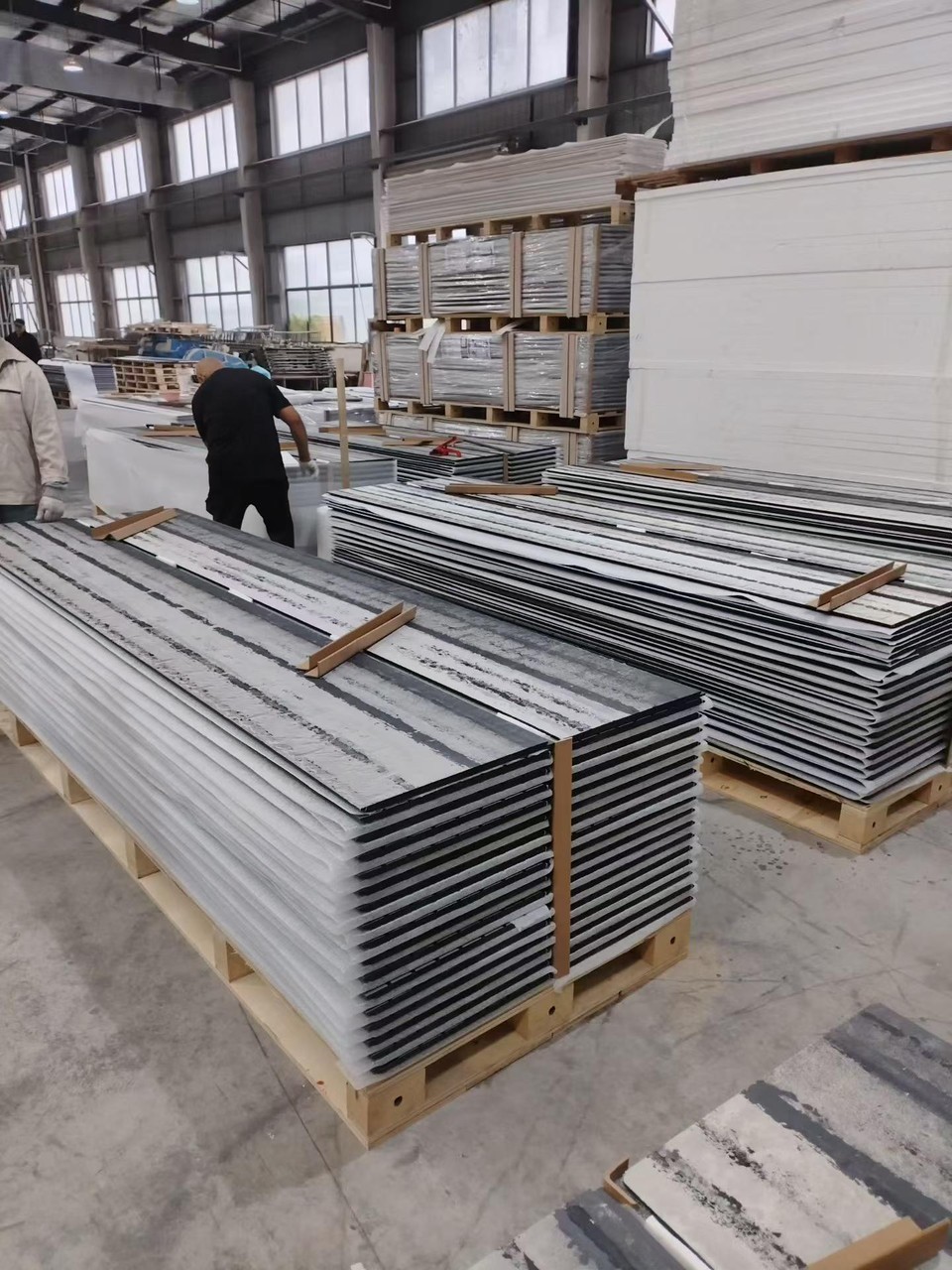
Inside one pallet: 66 panels
One fiber cement board pallet carries 66 panels. Packed, it measures 3,050 × 800 × 1,000 mm — the length is the 3,030 mm panel plus the pallet overhang, the width gives the forklift room to lift without touching the panel edge, and the height is set so two pallets stack inside a standard container with clearance.
The build-up, from the bottom:
A timber pallet, sized so the deck supports the full panel area rather than four points. A pallet that is too short puts the load on the middle of the panel and the bottom sheets arrive curved.
EPE foam between every single panel. Not every fifth, not at the ends — every one. The foam is an expanded polyethylene sheet that compresses under load and recovers, so it absorbs the vibration that would otherwise be transferred face to face.
Paper wrap around the full perimeter, folding over all four edges. The corners are the most fragile part of a cement board and the most exposed part of a stack, and paper wrap is the cheapest way to keep a corner intact.
Strapping around the pallet to hold the stack together, with timber bearers on top so the straps bear on timber rather than on the coating.
A top cover over the whole stack, so the upper pallet's pallet base never sits directly on a coated face.
The order matters as much as the components. Foam applied after the stack is built protects nothing; foam laid panel by panel is what keeps the faces apart for the whole journey.
Why expanded polyethylene and not cardboard
Buyers often ask why the interleaving is foam rather than cheaper board or paper.
Cardboard compresses to nothing under a 1,000 mm stack and takes on moisture in a container, at which point it stops cushioning and starts staining. Expanded polyethylene stays elastic across the temperature range of a sea freight, does not absorb water, and does not shed fibres onto a coated face.
There is a cost argument too, and it usually fails. Foam adds a few percent to the packing cost of a pallet; a single replaced panel shipped by air freight costs more than the foam on the whole container. The foam is the cheap part of the decision.
It also solves the abrasion problem. A textured panel has high points, and high points carry all the load. Without a compressible layer between panels, those points grind against the flat back of the panel above, and the marks appear as polished patches under raking light — a defect that cannot be repaired on site, only replaced.
Edge protection: the detail that prevents most claims
Every pallet is wrapped in paper at the full perimeter, with all four edges folded and covered.
This looks like a small thing and it is where most transit damage starts. A cement board corner has almost no ability to absorb energy: strike it and a triangular piece leaves the panel. That broken corner then cannot be used at an external corner detail, which is exactly where the panel would have been most useful, so the damage costs more than the panel — it costs the module.
Paper wrap absorbs the light contact that happens in every container: the pallet next to it during lashing, the strap tension, the container door during unloading. It does not stop a forklift, and no packaging does.
One practical note for site storage, because packing continues to matter after delivery. Leave the wrap on until the panel is about to be fixed. A stack that is unwrapped on arrival and stored on bare ground for two weeks picks up exactly the edge damage the wrap was there to prevent, and the argument about who caused it is unwinnable for both sides.
Loading a container: 12 pallets, 792 panels
A 40 ft container takes 12 pallets, which is 792 panels — a little over 1,090 m² of finished wall at 1.379 m² per panel.
The pattern is three pallets along the length, two across the width, stacked two high. Three pallets at 3,050 mm run to 9,150 mm of the container's 12,032 mm internal length; two at 800 mm occupy 1,600 mm of the 2,352 mm internal width, which leaves space for the lashing rather than forcing the last pallet against the wall.
Two practical consequences for the buyer.
The container is loaded by pallet, not by panel, so a part pallet at the end of a run is a decision made at packing, not at loading. If you order 700 panels rather than 792, you are paying for container space you are not using.
Loading sequence matters at the destination too. Pallets are loaded so that the first panels out are the ones needed first on site, if the buyer tells us the sequence at order stage.
What to check when the container is opened
Five checks, in order, before anything is signed.
Photograph the doors before opening. If there is damage inside and the door face is undocumented, the claim is weak.
Check the strapping and the top covers first. Intact strapping means the stack did not shift; a broken strap means something moved, and the panels under it need inspection.
Look at the corners before the faces. Corner damage is fast to see and tells you how the container was handled.
Check for condensation on the inner faces of the container walls and on the top cover. Water there means the load crossed a climate boundary badly, and the panels below need to be checked for staining rather than breakage.
Count before unloading, not after. Once panels are on the ground in a mixed stack, a shortage claim becomes an argument.
Photograph each stage as you go. A sequence of images from closed doors to open pallets is what a claim is actually decided on.
Packaging is a specification item, not a courtesy
If you are comparing suppliers, ask for the packing drawing rather than the packing description. The drawing shows panel count per pallet, pallet dimensions, foam thickness, strapping positions and the loading pattern for your container size. A supplier who cannot produce it is packing by habit.
Three questions that sort the answer quickly. How many panels per pallet, and what are the packed dimensions? Is foam between every panel or only at the ends? What is the container loading pattern, and how many pallets does it hold?
The answers should be numbers, and they should multiply out to your order. Ours are 66, 3,050 × 800 × 1,000 mm, and twelve pallets to a 40 ft container at 792 panels.
A sample shipment is a useful test of the same thing. A supplier who sends three loose panels by courier will pack a container with the same care. Ask for the sample packed the way the production order will be, and look at what arrives.
FAQ
How many fiber cement boards fit in a 40 ft container? Our 3,030 × 455 × 16 mm panel ships 792 pieces per 40 ft container, on 12 pallets of 66 panels each, roughly 1,090 m² of wall area.
How is fiber cement board packed for export? 66 panels to a pallet at 3,050 × 800 × 1,000 mm, with EPE foam between every panel, the full perimeter wrapped in paper, strapped, and 12 pallets loaded two high in a 40 ft container.
Is foam used between every panel? Yes, EPE foam is laid between every panel, not only at the ends of the stack. It absorbs vibration and protects the textured face from abrasion.
How are the edges protected? The full perimeter is wrapped in paper with all four edges folded and covered, which is where most transit damage would otherwise start.
Can the pallet size be changed for a 20 ft container? Pallet dimensions are set by the panel, so the panel count per pallet is the variable. Tell us the container type at order stage and the loading pattern is calculated from it.
Contact Us